Apollonius
Of Tyana believed in prayer,but how differently from the vulgar.For him the idea
that the Gods could be swayed from the path of rigid justice by the
entreaties of men, was a blasphemy; that the Gods could be made parties
to our selfish hopes and fears was to our philosopher unthinkable. One
thing alone he knew, that the Gods were the ministers of right and the
rigid dispensers of just desert.The common belief, which has persisted to
our own day, that God can be swayed from His purpose, that compacts
could be made with Him or with His ministers, was entirely abhorrent to
Apollonius.Beings with whom such pacts could be made, who could be
swayed and turned, were not Gods but less than men. And so we find
Apollonius as a youth conversing with one of the priests of Aesculapius
as follows:“Since then the Gods know all things, I think that one who
enters the temple with a right conscience within him should pray thus:
‘Give me, ye Gods, what is my due!’ “ (i II).And thus again on his long
journey to India he prayed at Babylon: “God of the sun, send thou me
o’er the earth so far as e’er ‘tis good for Thee and me; and may I come
to know the good, and never know the bad nor they know me” (i 31).One of
his most general prayers, Damis tells us, was to this effect: “Grant
me, ye Gods, to have little and need naught” (i 34).“When you enter the
temples, for what do you pray?” asked the Pontifex Maximus Telesinus of
our philosopher. “I pray,” said Apollonius, “that righteousness may
rule, the laws remain unbroken, the wise be poor and others rich, but
honestly” (iv 40).
The belief of the philosopher in the
grand ideal of having nothing and yet possessing all things, is
exemplified by his reply to the officer who asked him how he dared enter
the dominions of Babylon without permission. “The whole earth,” said
Apollonius, “is mine; and it is given me to journey through it”(i
21).There are many instances of sums of money being offered to
Apollonius for his services, but he invariably refused them; not only so
but his followers also refused all presents. On the occasion when King
Vardan, with true Oriental generosity, offered them gifts, they turned
away; whereupon Apollonius said: “You see, my hands, though many, are
all like each other.” And when the king asked Apollonius what present he
would bring him back from India, our philosopher replied: “A gift that
will please you, sire.For if my stay there should make me wiser, I shall
come back to you better than I am” (i 41).When they were crossing the
great mountains into India a conversation is said to have taken place
between Apollonius and Damis, which presents us with a good instance of
how our philosopher ever used the incidents of the day to inculcate the
higher lessons of life. The question was concerning the “below” and
“above.” Yesterday, said Damis, we were below in the valley; today we
are above, high on the mountains, not far distant from heaven.So this
is what you mean by“below” and “above,” said Apollonius gently. Why, of
course, impatiently retorted Damis, if I am in my right mind; what need
of such useless questions? And have you acquired a greater knowledge of
the divine nature by being nearer heaven on the tops of the mountains?
continued his master. Do you think that those who observe the heaven
from the mountain heights are any nearer the understanding of things?
Truth to tell, replied Damis, somewhat crestfallen, I did think I should
come down wiser, for I’ve been up a higher mountain than any of them,
but I fear I know no more than before I ascended it. Nor do other men,
replied
Apollonius; “such observations make them see the heavens
more blue, the stars more large, and the sun rise from the night, things
known to those who tend the sheep and goats; but how God doth take
thought for human kind, and how He doth find pleasure in their service,
and what is virtue, righteousness and commonsense, that neither Athos
will reveal to those who scale his summit nor yet Olympus who stirs the
poet’s wonder, unless it be the soul perceive them; for should the soul
when pure and unalloyed essay such heights, I swear to thee, she wings
her flight far far beyond this lofty Caucasus” (ii 6).
So
again, when at Thermopylæ his followers were disputing as to which was
the highest ground in Greece, Mt OEta being then in view. They happened
to be just at the foot of the hill on which the Spartans fell
overwhelmed with arrows.Climbing to the top of it Apollonius cried out:
“And I think this the highest ground, for those who fell here for
freedom’s sake have made it high as OEta and raised it far above a
thousand of Olympuses” (iv 23).Another instance of how Apollonius turned
chance happenings to good account is the following. Once at Ephesus, in
one of the covered walks near the city, he was speaking of sharing our
goods with others,and how we ought mutually to help one another. It
chanced that a number of sparrows were sitting on a tree hard by in
perfect silence. Suddenly another sparrow flew up and began chirping, as
though it wanted to tell the others something. Whereupon the little
fellow all set to a-chirping also, and flew away after the
newcomer. Apollonius’ superstitious audience were greatly struck by this
conduct of the sparrows, and thought it was an augury of some important
matter. But the philosopher continued with his sermon.The sparrow, he
said, has invited his friends to a banquet. A boy slipped down in a lane
hard by and spilt some corn he was carrying in a bowl; he picked up
most of it and went away. The little sparrow,chancing on the scattered
grains, immediately flew off to invite his friends to the feast.
Thereon
most of the crowd went off at a run to see if it were true, and when
they came back shouting and all agog with wonderment, the philosopher
continued: “Ye see what care the sparrows take of one another, and how
happy they are to share their goods. And yet we men do not approve; nay,
if we see a man sharing his goods with other men, we call it
wastefulness, extravagance, and by such names, and dub the men to whom
he gives a share, fawners and parasites. What then is left to us except
to shut us up at home like fattening birds, and gorge our bellies in the
dark until we burst with fat?” (iv 3).On another occasion, at Smyrna,
Apollonius, seeing a ship getting under weigh, used the occasion for
teaching the people the lesson of cooperation. “Behold the vessel’s
crew!” he said. “How some have manned the boats, some raise the anchors
up and make them fast, some set the sails to catch the wind,how others
yet again look out at bow and stern. But if a single man should fail to
do a single one of these his duties,or bungle in his seamanship, their
sailing will be bad, and they will have the storm among them. But if
they strive in rivalry each with the other, their only strife being that
no man shall seem worse than his mates, fair havens shall there be for
such a ship, and all good weather and fair voyage crowd in upon it” (iv
9).Again, on another occasion, at Rhodes, Damis asked him if he thought
anything greater than the famous Colossus. “I do,” replied Apollonius;
“the man who walks in wisdom's guileless paths that give us health”(v
21).
There is also a number of instances of witty or
sarcastic answers reported of our philosopher, and indeed, in spite of
his generally grave mood, he not unfrequently rallied his hearers, and
sometimes, if we may say so, chaffed the foolishness out of them (see
especially iv 30).Even in times of great danger this characteristic
shows itself.A good instance is his answer to the dangerous question of
Tigellinus,“What think you of Nero ? ” “I think better of him than you
do,” retorted Apollonius,“for you think he ought to sing, and I think he
ought to keep silence” (iv 44).So again his reproof to a young Croesus
of the period is as witty as it is wise. “Young sir,” he said, “methinks
it is not you who own your house, but your house you” (v 22).Of the
same style also is his answer to a glutton who boasted of his gluttony.
He copied Hercules, he said, who was as famous for the food he ate as
for his labours.“Yes,” said Apollonius, “for he was Hercules. But you,
what virtue have you, midden-heap?Your only claim to notice is your
chance of being burst” (iv 23).But to turn to more serious occasions. In
answer to Vespasian’s earnest prayer, “Teach me what should a good king
do,” Apollonius is said to have replied somewhat in the following
words:“You ask me what can not be taught. For kingship is the greatest
thing within a mortal’s reach;it is not taught. Yet will I tell you what
if you will do, you will do well. Count not that wealth which is stored
up - in what is this superior to the sand haphazard heaped? nor that
which comes from men to groan beneath taxation's heavy weight - for gold
that comes from tears is base and black. You’ll use wealth best of any
king, if you supply the needs of those in want and make their wealth
secure for those with many goods. Be fearful of the power to do whate’er
you please, so will you use it with more prudence. Do not lop off the
ears of corn that show beyond the rest and raise their heads - for
Aristotle is not just in this [See Chassang, op. cit., p 458, for a
criticism on this statement.]—but rather weed their disaffection out
like tares from corn, and show yourself a fear to stirrers up of strife
not in ‘I punish you’ but in ‘ I will do so.’ Submit yourself to law, O
prince, for you will make the laws with greater wisdom if you do not
despise the law yourself. Pay reverence more than ever to the Gods;
great are the gifts you have received from them, and for great
things you pray. [This was before Vespasian became emperor.] In what
concerns the state act as a king; in what concerns yourself, act as a
private man”(v 36).And so on much in the same strain, all good advice
and showing a deep knowledge of human affairs.And if we are to suppose
that this is merely a rhetorical exercise of Philostratus and not based
on the substance of what Apollonius said, then we must have a higher
opinion of the rhetorician than the rest of his writings warrant.
There
is an exceedingly interesting Socratic dialogue between Thespesion, the
abbot of the Gymnosophist community, and Apollonius on the comparative
merits of the Greek and Egyptian ways of representing the Gods. It runs
somewhat as follows;“What! Are we to think,” said Thespesion, “that the
Pheidiases and Praxiteleses went up to heaven and took impressions of
the forms of the Gods, and so made an art of them, or was it something
else that set them a-modeling?”“Yes, something else,” said Apollonius,
“something pregnant with wisdom.”“What was that? Surely you cannot say
it was anything else but imitation?” “Imagination wrought them - a
workman wiser far than imitation; for imitation only makes what it has
seen, whereas imagination makes what it has never seen, conceiving it
with reference to the thing it really is.”
Imagination,
says Apollonius, is one of the most potent faculties, for it enables us
to reach nearer to realities. It is generally supposed that Greek
sculpture was merely a glorification of physical beauty, in itself quite
unspiritual. It was an idealisation of form and features, limbs and
muscles, an empty glorification of the physical with nothing of course
really corresponding to it in the nature of things. But Apollonius
declared it brings us nearer to the real, as Pythagoras and Plato
declared before him, and as all the wiser teach.He meant this
literally, not vaguely and fantastically. He asserted that the types and
ideas of things are the only realities. He meant that between the
imperfection of the earth and the highest divine type of all things,
were grades of increasing perfection. He meant that within each man was a
form of perfection, though of course not yet absolutely perfect. That
the angel in man, his dæmon, was of God-like beauty, the summation of
all the finest features he had ever worn in his many lives on earth.The
Gods, too, belonged to the world of types, of models, of perfections ,
the heaven-world. The Greek sculptors had succeeded in getting in
contact with this world, and the faculty they used was imagination.This
idealisation of form was a worthy way to represent the Gods; but, says
Apollonius, if you set up a hawk or owl or dog in your temples, to
represent Hermes or Athena or Apollo, you may dignify the animals, but
you make the Gods lose dignity. To this Thespesion replies that the
Egyptians dare not give any precise form to the Gods; they give them
merely symbols to which an occult meaning is attached.Yes, answers
Apollonius, but the danger is that the common people worship these
symbols and get unbeautiful ideas of the Gods. The best thing would be
to have no representations at all. For the mind of the worshipper can
form and fashion for himself an image of the object of his worship
better than any art.Quite so, retorted Thespesion, and then added
mischievously: There was an old Athenian, by-the-by - no fool - called
Socrates, who swore by the dog and goose as though they were Gods.Yes,
replied Apollonius, he was no fool. He swore by them not as being Gods,
but in order that he might not swear by the Gods (iv 19).
This
is a pleasant passage of wit, of Egyptian against Greek, but all such
set arguments must be set down to the rhetorical exercises of
Philostratus rather than to Apollonius, who taught as “one having
authority,” as “from a tripod.” Apollonius, a priest of universal
religion, might have pointed out the good side and the bad side of both
Greek and Egyptian religious art, and certainly taught the higher way of
symbol-less worship, but he would not champion one popular cult against
another. In the above speech there is a distinct prejudice against
Egypt and a glorification of Greece, and this occurs in a very marked
fashion in several other speeches. Philostratus was a champion of Greece
against all comers; but Apollonius, we believe, was wiser than his
biographer.In spite of the artificial literary dress that is given to
the longer discourses of Apollonius, they contain many noble thoughts,
as we may see from the following quotations from the conversations of
our philosopher with his friend Demetrius,who was endeavouring to
dissuade him from braving Domitian at Rome. The
law, said Apollonius, obliges us to die for liberty, and nature ordains
that we should die for our parents, our friends, or our children. All
men are bound by these duties. But a higher duty is laid upon the sage;
he must die for his principles and the truth he holds dearer than life.
It is not the law that lays this choice upon him, it is not nature; it
is the strength and courage of his own soul. Though fire or sword
threaten him, it will not overcome his resolution or force him from the
slightest falsehood; but he will guard the secrets of others’ lives and
all that has been entrusted to his honour as religiously as the secrets
of initiation.And I know more than other men, for I know that of all
that I know, I know some things for the good, some for the wise, some
for myself, some for the Gods, but naught for tyrants.Again, I think
that a wise man does nothing alone or by himself; no thought of his so
secret but that he has himself as witness to it. And whether the famous
saying “know thyself” be from Apollo or from some sage who learnt to
know himself and proclaimed it as a good for all, I think the wise man
who knows himself and has his own spirit in constant comradeship, to
fight at his right hand, will neither cringe at what the vulgar fear,
nor dare to do what most men do without the slightest shame (vii 15).In
the above we have the true philosopher’s contempt for death, and also
the calm knowledge of the initiate, of the comforter and adviser of
others to whom the secrets of their lives have been confessed, that no
tortures can ever unseal his lips. Here, too, we have the full knowledge
of what consciousness is of the impossibility of hiding the smallest
trace of evil in the inner world and also the dazzling brilliancy of a
higher ethic which makes the habitual conduct of the crowd appear
surprising - the“that which they do - not with shame.''

Μπορούμε εύκολα να συγχωρέσουμε ένα παιδί που φοβάται το σκοτάδι, η αληθινή τραγωδία της ζωής όμως είναι όταν οι ενήλικοι φοβούνται το φως....-Πλάτων-
Εμφάνιση αναρτήσεων με ετικέτα Asclepius. Εμφάνιση όλων των αναρτήσεων
Εμφάνιση αναρτήσεων με ετικέτα Asclepius. Εμφάνιση όλων των αναρτήσεων
Τρίτη 11 Δεκεμβρίου 2012

Κυριακή 5 Αυγούστου 2012
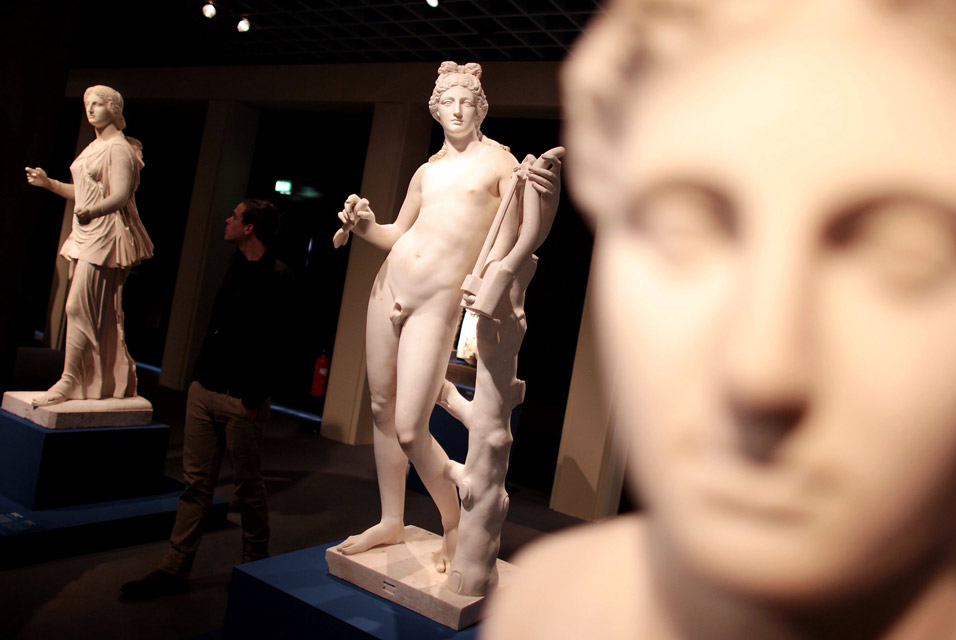
Olympian world of the Greek gods recreated

Greek poets and artists conveyed a vivid
picture of the world of these gods. Their work set creative precedents
and were a source of inspiration; they also furnished models and a
stim-ulus for new interpretations and original compositions by Roman
writers and sculptors.
Over a period of more than three hundred
years, the Brandenburg-Prussian Electors and Kings in Berlin collected
antique works of art, which are now in the museums of the ‘Preußischer
Kulturbesitz’ Foundation – the Pergamon Museum and the Collection of
Antiquities. For the first time in Cologne, in the exhibition The
Return of the Gods, the Olympian world of the Greek gods is recreated
with marble statues, stone reliefs, bronzes and luxurious vases from the
Berlin collections – a cross section of outstanding European art from
early Greek times to the imperial Roman period.
Zeus, Hades, Poseidon – the Father Gods
Zeus, the Romans’ Jupiter, was the majestic ruler of the Olympian world. As the lord of the heavens, he carried a thunderbolt as his weapon. Zeus was the father of nu-merous gods and heroes; most of his offspring were not begotten with his wife Hera, but were the result of his many erotic liaisons.
Zeus, the Romans’ Jupiter, was the majestic ruler of the Olympian world. As the lord of the heavens, he carried a thunderbolt as his weapon. Zeus was the father of nu-merous gods and heroes; most of his offspring were not begotten with his wife Hera, but were the result of his many erotic liaisons.
Poseidon was the master of the sea,
inland waters and storms. As the “shaker of the Earth”, who made the
Earth tremble with his trident, he was held responsible for earthquakes
and natural disasters. People also venerated him as the protector of
their ships. The Romans called this god Neptune.
Brother of Zeus and Poseidon was Hades,
the Romans’ Pluto. He became the lord of the underworld when the gods
drew lots to divide the world between them.
All these “Father Gods” are represented
as mature, dignified and mighty. Zeus the father of the gods, Hades the
ruler of the underworld and Poseidon the god of the sea, are difficult
to tell apart when not depicted with their characteristic attributes
Asclepius, the Healing God
Asclepius was the god of medicine and healing. He was the son of Apollo and a mortal woman, so merely a demigod. He was nevertheless worshipped as a god but not regarded as one of the Olympian gods.
Asclepius’ place was among the people.
He is represented in the likeness of a Greek citizen: bearded, wearing a
robe and leaning on a staff. A snake is coiled around his staff and the
staff (or rod) of Asclepius is still the traditional symbol of
medicine.
Asclepius had many sanctuaries that
attracted throngs of worshippers, where the sick sought cures through
healing sleep (incubation). A centre of his cult developed at Epidaurus
and another was located on the island of Kos. The physicians of Kos
achieved great fame in the 5th century BC. The best known was
Hippocrates and, even today, doctors swear the “Hippocratic Oath”.
The cult of Asclepius reached the
western part of the Roman Empire in 293 BC when the Epidaurus sanctuary
established a shrine to the Latinised Aesculapius on Rome’s Tiber
Island.
Hera and Demeter – the Mothers
Hera, the Romans’ Juno, was the sister and spouse of Zeus. As the queen of the gods she watched over marriage and legitimate offspring. She therefore pursued the amorous escapades of her husband with jealous severity.
Demeter, Ceres for the Romans, was the
goddess of the fertile earth, of grain and agriculture. According to the
“Homeric” hymn to Demeter, her daughter Kore was abducted by Hades and,
as Persephone/Proserpina, became his wife in the under-world. Searching
for her daughter, the desperate Demeter neglected her responsibilities
as the goddess of agriculture, which led to a severe drought. Only after
the return of her daughter for two-thirds of the year did she allow
everything to grow and flourish again, but Kore-Persephone had to spend
one third of each year with Hades in the underworld, during which time
nature was also dead.Demeter and Hera are usually depicted as
motherly goddesses, often wearing a dia-dem and veil. When ears of
wheat – a specific attribute of Demeter – are not shown, it is scarcely
possible to distinguish between the two.
Aphrodite and Hermes
Aphrodite’s sphere of influence was love; her son Eros was the personified god of love. From the 5th century BC onwards, Aphrodite was depicted in ever more reveal-ing clothes: light and flimsy garments accentuated the beauty of the female body. Aphrodite first appeared completely naked in the 4th century BC, as a statue by Praxiteles, whose visualisation of the goddess was widely copied. Venus, the Roman equivalent of Aphrodite, was said to be the mother of Aeneas. Hence she became the mythical ancestress of the family of the Julii, to which both Caesar and Augustus belonged.Hermes was the messenger of the gods, the god of roads, boundaries and herds-men, the patron of thieves. He guided the souls of the dead into the after-world.Hermes wore the clothes of a traveller: a short cape, a broad-brimmed hat and boots or sandals. Speed was suggested by wings attached to his hat, shoes or heels. In addition, he carried a messenger’s staff with two snakes (Kerykeion). The Roman equivalent of Hermes was Mercury, the god of commerce and economic prosperity.
Athena – the Patroness of Great Works
Athena was the wise daughter of Zeus. Before his marriage to Hera, Zeus was the husband of Metis, the goddess of wisdom. Zeus then swallowed his consort when she was pregnant with Athena because it had been prophesied that she would bear him a child stronger than himself, who would ultimately depose him. Athena was born when Hephaestus, the blacksmith god, cleaved open her father’s skull.Athena was the goddess of battle, depicted with a helmet, lance and shield. Another emblem was the “aegis”, a breastplate with the head of the Gorgon Medusa in the centre. Athena was the patroness of the crafts and all artistic activities. She is also said to have invented the flute. While playing it beside a stream, she saw a reflection of herself with her cheeks puffed out, and crossly cast the instrument aside. The satyr Marsyas retrieved the flute and later challenged Apollo to a musical contest.Many cities invoked the protection of Athena, especially Athens, where she was worshipped on the Acropolis. Her Roman equivalent was Minerva.
Apollo and Artemis – divine twins
The twins Apollo and Artemis were the children of Zeus and Leto. Jealous Hera pur-sued her rival relentlessly until, finally, the island of Delos allowed Leto to give birth to her children there.Apollo was the upholder of order in human society, slaying wrongdoers with his bow and sending pestilence as a punishment. He defended religious purity. His attribute was the laurel. He was also the god of oracles and divine prophesies, leader of the muses and a master of the lyre. He was depicted as an idealized youth with long hair.Artemis, the goddess of the hunt and huntsmen, represented unspoiled nature. Known since ancient times as the “Mistress of the Animals” and the “unconquered virgin”, she nurtured and protected young animals, but was also a huntress who killed her prey. Since the late classical period, she has usually been depicted as a young girl in a hunting tunic with a bow and a quiver full of arrows, often accompanied by an animal. Just as her brother was both the god of healing and the god of pestilence, so Artemis was the goddess of childbirth and the bringer of death in childbirth.
The Sanctuary
In the Greek and Roman world, the sanctuary was the most important place for wor-shipping the gods. People would go there with votive offerings and gifts to praise or appease a deity and to ask for favours.
At larger ritual sites there were
temples with a cult image of the god. However, the centre of the
sanctuary was always the altar where sacrifices were offered. At public
ceremonies, cattle were often sacrificed: the priests would burn the
bones, fat and hide of the animal as an offering to the gods; the meat
would then be consumed by the worshippers at a ritual feast. Individual
citizens usually donated smaller animals, fruit or libations. The rites
could be accompanied by processions, dancing and music.
An abundance of offerings of various
types would accumulate at such sacred sites. Large objects like statues
would be set up on display while smaller votive objects, such as
miniature figurines or weapons captured from the enemy, were deposited
somewhere. In large Greek sanctuaries, Olympia and Delphi for example,
there were also treasuries where valuable offerings were stored.
Dionysus and the Theatre
Dionysus was the god of wine and delirious ecstasy. Those who gave themselves to this god had to risk becoming “possessed”. Dionysus was surrounded by a retinue (thiasos) of half-wild hybrid creatures, youthful satyrs, older sileni, and frenzied maenads who often danced to the music of flutes and drums.
Dionysus was depicted as child, as a
seductive youth with a body that is sometimes rather feminine, and as an
old man leaning on a satyr. His attributes were the ivy, either as a
wreath to prevent intoxication or wound around a staff (thyrsos), and a
drinking vessel (kantharos). He always symbolised a hedonistic way of
life.
Greek theatre originated in the cult of
Dionysus. In many places of worship, dramatic performances were part of
his festivals. Starting in Athens in the 6th century BC, first
tragedies, then “satyr” plays and – after 486 BC – comedies were
performed during the Great Dionysia festival. All the roles in the
plays, even female roles, were taken by three male actors wearing
costumes and masks, accompanied by a choir.
The Pergamon Altar
In the conflicts to succeed Alexander the Great, Philhetairos was able to establish his rule in Asia Minor, at Pergamon. His grandson, Attalos I, took the title of King. The latter’s son, Eumenes II (197-159 BC), defeated the invading Celts and developed the fortress into a Hellenistic city with prestigious marble buildings.The religious centre was the altar of Zeus, which was visible from afar. A flight of steps led up to a podium and the colonnaded area with the altar for burnt offerings. The podium was decorated on all sides by a frieze depicting the battle of the gods against the giants. The rear walls illustrated the history of the founding of Pergamon. Acroteria with figures stood on the roof.
Εγγραφή σε:
Αναρτήσεις (Atom)