Εμφάνιση αναρτήσεων με ετικέτα Athena. Εμφάνιση όλων των αναρτήσεων

Κυριακή 5 Αυγούστου 2012

Olympian world of the Greek gods recreated

COLOGNE.- Even today, the world of the ancient Greek gods has lost none of its fascination. Accounts of the deeds of mighty Zeus, his jealous wife Hera, the twins Apollo and Artemis, beautiful Aph-rodite, and Dionysos the god of wine, are as enthralling as ever after more than 2000 years.
Greek poets and artists conveyed a vivid picture of the world of these gods. Their work set creative precedents and were a source of inspiration; they also furnished models and a stim-ulus for new interpretations and original compositions by Roman writers and sculptors.
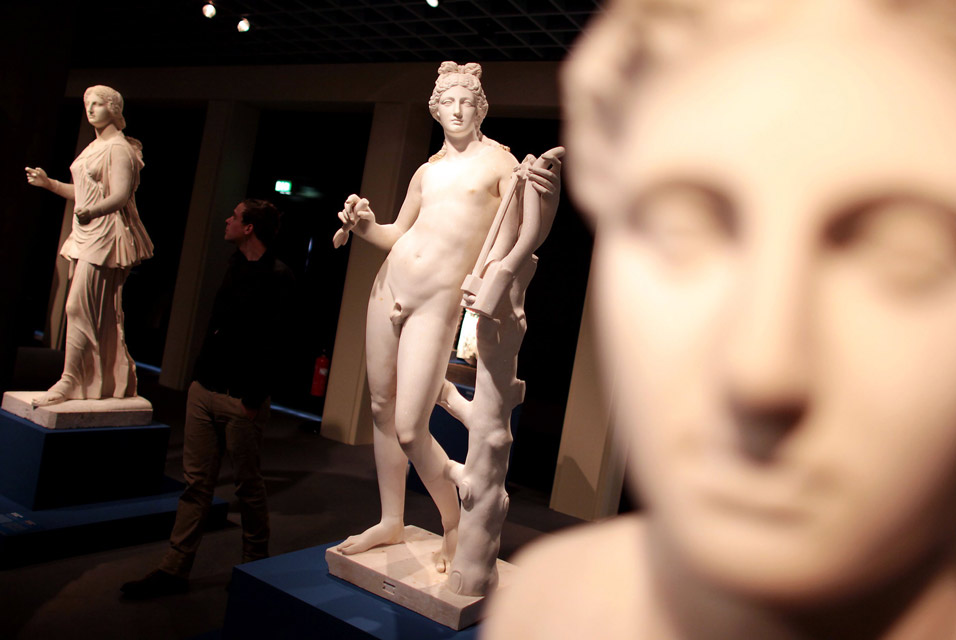
Over a period of more than three hundred years, the Brandenburg-Prussian Electors and Kings in Berlin collected antique works of art, which are now in the museums of the ‘Preußischer Kulturbesitz’ Foundation – the Pergamon Museum and the Collection of Antiquities. For the first time in Cologne, in the exhibition The Return of the Gods, the Olympian world of the Greek gods is recreated with marble statues, stone reliefs, bronzes and luxurious vases from the Berlin collections – a cross section of outstanding European art from early Greek times to the imperial Roman period.

Zeus, Hades, Poseidon – the Father Gods
Zeus, the Romans’ Jupiter, was the majestic ruler of the Olympian world. As the lord of the heavens, he carried a thunderbolt as his weapon. Zeus was the father of nu-merous gods and heroes; most of his offspring were not begotten with his wife Hera, but were the result of his many erotic liaisons.
Poseidon was the master of the sea, inland waters and storms. As the “shaker of the Earth”, who made the Earth tremble with his trident, he was held responsible for earthquakes and natural disasters. People also venerated him as the protector of their ships. The Romans called this god Neptune.
Brother of Zeus and Poseidon was Hades, the Romans’ Pluto. He became the lord of the underworld when the gods drew lots to divide the world between them.
All these “Father Gods” are represented as mature, dignified and mighty. Zeus the father of the gods, Hades the ruler of the underworld and Poseidon the god of the sea, are difficult to tell apart when not depicted with their characteristic attributes

Asclepius, the Healing God
Asclepius was the god of medicine and healing. He was the son of Apollo and a mortal woman, so merely a demigod. He was nevertheless worshipped as a god but not regarded as one of the Olympian gods.
Asclepius’ place was among the people. He is represented in the likeness of a Greek citizen: bearded, wearing a robe and leaning on a staff. A snake is coiled around his staff and the staff (or rod) of Asclepius is still the traditional symbol of medicine.
Asclepius had many sanctuaries that attracted throngs of worshippers, where the sick sought cures through healing sleep (incubation). A centre of his cult developed at Epidaurus and another was located on the island of Kos. The physicians of Kos achieved great fame in the 5th century BC. The best known was Hippocrates and, even today, doctors swear the “Hippocratic Oath”.
The cult of Asclepius reached the western part of the Roman Empire in 293 BC when the Epidaurus sanctuary established a shrine to the Latinised Aesculapius on Rome’s Tiber Island.

Hera and Demeter – the Mothers
Hera, the Romans’ Juno, was the sister and spouse of Zeus. As the queen of the gods she watched over marriage and legitimate offspring. She therefore pursued the amorous escapades of her husband with jealous severity.
Demeter, Ceres for the Romans, was the goddess of the fertile earth, of grain and agriculture. According to the “Homeric” hymn to Demeter, her daughter Kore was abducted by Hades and, as Persephone/Proserpina, became his wife in the under-world. Searching for her daughter, the desperate Demeter neglected her responsibilities as the goddess of agriculture, which led to a severe drought. Only after the return of her daughter for two-thirds of the year did she allow everything to grow and flourish again, but Kore-Persephone had to spend one third of each year with Hades in the underworld, during which time nature was also dead.Demeter and Hera are usually depicted as motherly goddesses, often wearing a dia-dem and veil. When ears of wheat – a specific attribute of Demeter – are not shown, it is scarcely possible to distinguish between the two.

Aphrodite and Hermes
Aphrodite’s sphere of influence was love; her son Eros was the personified god of love. From the 5th century BC onwards, Aphrodite was depicted in ever more reveal-ing clothes: light and flimsy garments accentuated the beauty of the female body. Aphrodite first appeared completely naked in the 4th century BC, as a statue by Praxiteles, whose visualisation of the goddess was widely copied. Venus, the Roman equivalent of Aphrodite, was said to be the mother of Aeneas. Hence she became the mythical ancestress of the family of the Julii, to which both Caesar and Augustus belonged.Hermes was the messenger of the gods, the god of roads, boundaries and herds-men, the patron of thieves. He guided the souls of the dead into the after-world.Hermes wore the clothes of a traveller: a short cape, a broad-brimmed hat and boots or sandals. Speed was suggested by wings attached to his hat, shoes or heels. In addition, he carried a messenger’s staff with two snakes (Kerykeion). The Roman equivalent of Hermes was Mercury, the god of commerce and economic prosperity.

Athena – the Patroness of Great Works
Athena was the wise daughter of Zeus. Before his marriage to Hera, Zeus was the husband of Metis, the goddess of wisdom. Zeus then swallowed his consort when she was pregnant with Athena because it had been prophesied that she would bear him a child stronger than himself, who would ultimately depose him. Athena was born when Hephaestus, the blacksmith god, cleaved open her father’s skull.Athena was the goddess of battle, depicted with a helmet, lance and shield. Another emblem was the “aegis”, a breastplate with the head of the Gorgon Medusa in the centre. Athena was the patroness of the crafts and all artistic activities. She is also said to have invented the flute. While playing it beside a stream, she saw a reflection of herself with her cheeks puffed out, and crossly cast the instrument aside. The satyr Marsyas retrieved the flute and later challenged Apollo to a musical contest.Many cities invoked the protection of Athena, especially Athens, where she was worshipped on the Acropolis. Her Roman equivalent was Minerva.

Apollo and Artemis – divine twins
The twins Apollo and Artemis were the children of Zeus and Leto. Jealous Hera pur-sued her rival relentlessly until, finally, the island of Delos allowed Leto to give birth to her children there.Apollo was the upholder of order in human society, slaying wrongdoers with his bow and sending pestilence as a punishment. He defended religious purity. His attribute was the laurel. He was also the god of oracles and divine prophesies, leader of the muses and a master of the lyre. He was depicted as an idealized youth with long hair.Artemis, the goddess of the hunt and huntsmen, represented unspoiled nature. Known since ancient times as the “Mistress of the Animals” and the “unconquered virgin”, she nurtured and protected young animals, but was also a huntress who killed her prey. Since the late classical period, she has usually been depicted as a young girl in a hunting tunic with a bow and a quiver full of arrows, often accompanied by an animal. Just as her brother was both the god of healing and the god of pestilence, so Artemis was the goddess of childbirth and the bringer of death in childbirth.

The Sanctuary
In the Greek and Roman world, the sanctuary was the most important place for wor-shipping the gods. People would go there with votive offerings and gifts to praise or appease a deity and to ask for favours.
At larger ritual sites there were temples with a cult image of the god. However, the centre of the sanctuary was always the altar where sacrifices were offered. At public ceremonies, cattle were often sacrificed: the priests would burn the bones, fat and hide of the animal as an offering to the gods; the meat would then be consumed by the worshippers at a ritual feast. Individual citizens usually donated smaller animals, fruit or libations. The rites could be accompanied by processions, dancing and music.
An abundance of offerings of various types would accumulate at such sacred sites. Large objects like statues would be set up on display while smaller votive objects, such as miniature figurines or weapons captured from the enemy, were deposited somewhere. In large Greek sanctuaries, Olympia and Delphi for example, there were also treasuries where valuable offerings were stored.

Dionysus and the Theatre
Dionysus was the god of wine and delirious ecstasy. Those who gave themselves to this god had to risk becoming “possessed”. Dionysus was surrounded by a retinue (thiasos) of half-wild hybrid creatures, youthful satyrs, older sileni, and frenzied maenads who often danced to the music of flutes and drums.
Dionysus was depicted as child, as a seductive youth with a body that is sometimes rather feminine, and as an old man leaning on a satyr. His attributes were the ivy, either as a wreath to prevent intoxication or wound around a staff (thyrsos), and a drinking vessel (kantharos). He always symbolised a hedonistic way of life.
Greek theatre originated in the cult of Dionysus. In many places of worship, dramatic performances were part of his festivals. Starting in Athens in the 6th century BC, first tragedies, then “satyr” plays and – after 486 BC – comedies were performed during the Great Dionysia festival. All the roles in the plays, even female roles, were taken by three male actors wearing costumes and masks, accompanied by a choir.

The Pergamon Altar
In the conflicts to succeed Alexander the Great, Philhetairos was able to establish his rule in Asia Minor, at Pergamon. His grandson, Attalos I, took the title of King. The latter’s son, Eumenes II (197-159 BC), defeated the invading Celts and developed the fortress into a Hellenistic city with prestigious marble buildings.The religious centre was the altar of Zeus, which was visible from afar. A flight of steps led up to a podium and the colonnaded area with the altar for burnt offerings. The podium was decorated on all sides by a frieze depicting the battle of the gods against the giants. The rear walls illustrated the history of the founding of Pergamon. Acroteria with figures stood on the roof.
The gigantomachy on the Pergamon Altar marks the pinnacle of Hellenistic art. It is the most complete antique depiction of the struggle of the younger generation of Olympian gods, together with Hercules, against the giants, born out of chaos, who were trying to destroy the new world order. Zeus with his lightning bolts is shown fighting a snake-footed giant, an allusion to the victory over the Celts

Παρασκευή 11 Μαΐου 2012

Poseidon the Greek God of the Sea

One of the twelve great Olympian gods, Poseidon was the Greek god of the sea whose fearsome rage could bring violent storms and earthquakes on the world. Homer calls him ''Earth-holder'' and as lord of earthquakes,Earth-shaker. He vividly depicts the mighty god as he journeys across his territory {Iliad 13.23-30): He harnessed to his chariot his two bronze-shod horses, swift of foot,with long, streaming manes of gold. Himself clothed in gold, he seized his well-wrought golden whip, then climbing into his chariot he drove across the waves. On every side, from the deeps of the sea, came dolphins,playing in his path, acknowledging their lord, and the sea parted in joy, cleaving a path before him. So swiftly sped the horses that never once was the axle of bronze beneath made wet with foam.

Poseidon was one of the six children of the Titans Cronus and Rhea, swallowed and later regurgitated by his cannibalistic father.When Cronus had been defeated and his three sons divided the universe among themselves, they kept the earth and Olympus as common property, while Zeus took the heavens as his domain, Hades the misty darkness of the Underworld, and Poseidon the seas. According to Homer, there was a time when Poseidon rebelled, conspiring with Hera and Athena to put Zeus in chains. But the sea-goddess Thetis saved him, sending Briareos  to release him.Poseidon vied with Apollo for the love of Hestia, the goddess of the hearth, but she rejected both of them, swearing a vow of eternal chastity. He also vied with Zeus for the love of Thetis, but both gods withdrew their suit when they learnt that she was destined to bear a son mightier than his father. Poseidon's wooing of the Nereid Amphitrite came to a happier conclusion: with the help of a dolphin,who found her when she fled into hiding, he won her for his wife.With her he lived in a splendid golden palace in the depths of the sea. She bore him a son, the merman Triton, and two daughters, Rhode and Benthesicyme. But Poseidon was one of the most prolific of the gods and fathered numerous children on many mistresses. He himself could be violent and vindictive, and some of his sons inherited his dangerous nature, such as the evil Sciron, Sinis and Cercyon,all killed by Theseus; the boxer Amycus, killed by Polydeuces;and the Egyptian king Busiris, killed by Heracles.Some of his formidable offspring were giants, such as the Siamese twins, the Moliones;Otus and Ephialtes, who attempted to take over Olympus;the wrestler Antaeus, who was killed by Heracles; the great hunter Orion; Lamus, who founded the Laestrygonians, a race of maneating giants; and perhaps best-known of all, the Cyclops Polyphemus, who was blinded by Odysseus.

Others of Poseidon's more famous children were the twins Pelias and Neius, whom he fathered on Tyro, taking the shape of the rivergod Enipeus; Libya's three sons, Belus, Agenor and Lelex; Eumolpus,the son of Chione(, who was thrown into the sea by his mother and reared by Poseidon's daughter Benthesicyme; the navigator Nauplius, fathered on the Danaid Amymone while she was hunting for water in Argos; Hippothoon, the son of Alope, who was suckled by a mare and reared by shepherds after Alope was cruelly killed by her father; and of course the great Athenian hero, Theseus, borne to Poseidon by Aethra.
Poseidon was also the god of horses, and in this guise was known as Poseidon Hippios, 'Horse Poseidon'. As a horse he mated with the goddess Demeter, who bore him the divine horse, Areion, and a daughter, Despoina. Medusa was pregnant by him when she was killed by Perseus, and from her severed neck were born the winged horse, Pegasus, and Chrysaor. Poseidon presented wondrous horses to favoured mortals, both to Pelops, to help him win the hand of Hippodameia, and to his son Idas, to help him win the hand of Marpessa. To Peleus he gave as a wedding present the immortal horses Xanthus and Balius, who were later taken by Achilles to fight at Troy. The god showed his favour to other mortals in rather different ways. He made love to Caenis while she was wandering alone on the seashore, then at her own request turned her into a man, Caeneus,and made her invulnerable. He also made his son Cycnus invulnerable, and on his death at Achilles' hands turned him into a swan.He gave to his mistress Mestra, daughter of Erysichtheon, and to his grandson Periclymenus the ability to change their shape at will.Like other sea-deities, Poseidon himself had the power of changing his own shape. He came to Theophane as a ram, and fathered on her the flying, talking ram with the golden fleece which saved Phrixus and Helle from their wicked stepmother Ino, and which later became the motive for the long and arduous journey of Jason and the Argonauts.According to Ovid, Poseidon coupled with Canace, the daughter of Aeolus, as a bull, with Melantho, the daughter of Deucalion,as a dolphin, and with the Gorgon Medusa as a bird.Being a mighty and formidable god,Poseidon sternly punished the mortals who offended him. He was furious with Odysseus for blinding the Cyclops Polyphemus and kept him away from his homeland of Ithaca for many long, weary years; and he punished the Phaeacians, the people of Scheria, for helping Odysseus on his journey.

When Laomedon, king of Troy, refused to pay Poseidon and Apollo the agreed wage for building his city walls, the sea-god sent a sea-monster against the land, which would have devoured Hesione,Laomedon's daughter, had she not been saved by Heracles. Laomedon's offence was the reason for Poseidon's resentment of the Trojans and his support for the Greeks during the Trojan War. He frequently intervened to help his favourites, even against the express command of Zeus. This did not stop him helping Athena to punish the Greeks at the end of the war for the rape of the Trojan prophetess Cassandra by Ajax the sea-god sent violent storms that wrecked the Greek fleet off Cape Caphareus and brought death to many, including Ajax himself.At the Nereid's request, Poseidon sent another sea-monster against the Ethiopians, to punish a vain boast made by their queen, Cassiopeia.This time the monster's victim was to be the queen's daughter, Andromeda, but she was saved by Perseus. Poseidon was also associated with bulls: he brought death to Hippolytus, at the request of his father Theseus, by sending a bull from the sea that caused his horses to bolt and overturn his chariot. He sent as a gift to Minos, king of Crete, a magnificent white bull from the sea, then punished the king for failing to sacrifice it by inflicting on his wife,Pasiphae, a passion for the bull that led to the birth of the Minotaur.Poseidon came into conflict with some of the other gods over the
patronship of certain lands. He and Athena contested the possession of Attica during the reign of Cecrops. Both demonstrated their divine powers, Poseidon by creating a well of sea-water on the Acropolis of Athens, Athena by planting an olive tree. Athena's was judged the greater benefit, so the land became hers. Poseidon in anger sent a flood to cover Attica. He also quarrelled with Hera over the possession of Argos. The river-gods Inachus, Cephissus and Asterion judged the dispute in favour of Hera, and Poseidon, angry once again, dried up their waters. He was more fortunate in the case of Corinth,which he disputed with the Sun-god, Helios. The Hundred-hander Briareos was called in as arbitrator, and he awarded the citadel of
Acrocorinth to Helios and the Isthmus to Poseidon.

Poseidon was worshipped throughout the Greek world and from very early times: his name occurs on Mycenean Linear B tablets more frequently than that of any other divinity. At Rome he was identified
with the sea-god Neptune. He is a popular subject in ancient art, easily recognised by his most famous attribute, the trident, though he sometimes holds a fish and is often accompanied by sea creatures.
Occasionally he rides a hippocamp (a hybrid with the foreparts of a horse and the tail of a fish). Popular too in postclassical art, he figures prominently in sea-triumphs with his wife Amphitrite and is a natural subject for fountain-figures, such as on the famous Trevi Fountain at Rome. His marble temple on the promontory of Sounion in Attica, built in the late fifth century BC, is still a landmark for sailors.

Πέμπτη 19 Ιανουαρίου 2012

The Legend Of Perseus


Once there was a king named Acrisius, he had a beautiful daughter named Danae. The oracle of Apollo told Acrisius that Danae's son would one day kill him. Acrisius could not let that happen, so he locked Danae in a bronze tower so that she would never marry or have children.
The tower had no doors, but it had one very small window. Danae was very sad, but one day a bright shower of gold came through the small window. A man appeared, he had a thunderbolt in his hand and Danae knew he was a god, but she didn't know which. The man said, "Yes, I am a god and I wish to make you my wife. I can make this dark prison a wonderful sunny land with many flowers "

All happened as he said, the horrible prison became fields almost as wonderful as the Elysian Fields themselves, but one day Acrisius saw light coming out of the small window. He told his men to tear down one of the walls. He walked into the tower and saw Danae with a baby on her lap, smiling she said, "I have named him Perseus." Acrisius was furious, he shut Danae and baby Perseus up in a large chest and cast them out to sea.

Somehow they got safely to the island of Seriphos where Polydectes was king. The kings brother who was a fisherman, caught them in his net and pulled them to shore, his name was Dictys. Perseus grew up to become a strong young man. Polydectes heard about Danae and wanted her to marry him, but she rejected him. Polydectes would have married Danae by force if Perseus wasn't there to protect her.

Polydectes decided on a plan to get rid of Perseus. Polydectes pretended to be marrying a daughter of a friend of his. Everybody had to bring a present, including Perseus. Polydectes pretended to be furious when Perseus arrived empty-handed, for he was not only very strong and brave but very poor. "What, no wedding present?" yelled Polydectes. " I don't have any money." exclaimed Perseus. " That's what you get for a lazy good-for-nothing." said Polydectes. Perseus was furious. "I can bring you any present in the world, anything." he said. "Then bring me the head of the gorgon Medusa!" replied Polydectes. "Fine!" said Perseus.

So he went of on his perilous voyage. For days he wandered, searching for the gorgons lair. One night in an unknown country he realized how hopeless things were. The gorgons were horrible, instead of hair they had black serpents that writhed on their head, they had brazen hands that could have squashed poor Perseus, but worst of all if you looked a gorgon you were instantly turned to stone.

Then suddenly a tall woman and a young man with winged sandals appeared. The man said, "I am Hermes and this is our sister Athena. Yes, you are a son of Zeus. We have some things that may help you in slaying Medusa. Here are my winged sandals and the sickle which Cronos used to overpower Uranus and Zeus used against mighty Typhoeus." "And here is a gifts from me." said Athena, "Use this shield to reflect the image of Medusa so you won't be turned to stone." "You must find the Graeae and get them to tell you how to get to the Nymphs of the North, they will give you the cap of darkness and give you a magic wallet and tell you how to get to the Gorgons' lair." Hermes said.

So Perseus went to the cave of the Graeae. The Graeae were strange women, there were three of them having only one eye for all three of them which they constantly fought over. Perseus hid behind some bushes and watched them. When one took out the eye to give to another Perseus sprang from his hiding place and snatched the eye from them. Then he said, "I have your eye and if you don't tell me how to find the Nymphs of the North you shall never have it back!" So they reluctantly told them how to find the Nymphs of the North. He gave them back their eye and flew off on his winged sandals.

The kindly Nymphs of the North gave him the Cap of Darkness which has the power to make it's wearer invisible and the magic wallet. They told him how to reach the gorgons' lair. Perseus went farther north until he found an island surrounded by rocks and statues which used to be men.
Perseus raised his shield and saw Medusa and her sisters asleep, he put on the Cap of Darkness and flew down. He swung the sickle and felt it tearing through sinew and bone. Still looking into the shield, he put Medusa's head in the magic wallet. Medusa's sisters woke up and attacked Perseus. He flew quickly away on his winged sandals and was not hurt.

On his way back to Seriphus he had many adventures, one was that when he saw the Atlas holding up the sky Perseus was sorry for Atlas and turned him to stone by showing him the head of Medusa so he could no longer feel the weight of his burden.
Later he saw what looked like a statue chained to a rock, he flew down. He saw that it was not a statue, but a woman. He asked why she was chained to the rock. "My name is Andromeda and I have been punished because of my vain mother. She boasted that I was more beautiful then the Nereids. Poseidon was angered and said that I must be sacrificed to a sea monster," she said. Even as she spoke a monster rose from the sea.

Perseus pulled Medusa's head out of the wallet and the sea monster turned to stone and crumbled to pieces. Perseus cut Andromada's chains and took her to her father, King Cepheus of Phoenicia. When Perseus asked Andromeda's hand in marriage Cepheus gladly agreed. So Perseus - with Andromeda in his arms set off for Seriphus.

On the way they stopped at Larisa so Perseus could compete in some games, but when he threw a discus it hit an old man in the stands who was Acrisius. So the prophecy came true and after mourning for a while Perseus and Andromeda left.

When they arrived at Seriphus, the first person they met was Dictys the fisherman who brought Danae and Perseus to shore after they sailed in the trunk. Dictys told Perseus and Andromeda how Polydectes had never really married, but since Danae wouldn't marry Polydectes, he forced her to be his handmaiden. Perseus was furious. He told Dictys to take care of Andromeda.
Perseus stormed to the palace, walked in and said, "Let all who are my friends shield their eyes!" So saying he raised Medusa's head and Polydectes and his courtiers were changed to statues. Perseus and Andromeda lived happily for many years and their descendants became great kings, but the greatest of these was Heracles the strongest man in the world.

Later Perseus was killed by Dionysus. Perseus and Andromeda were put up in the sky as constellations.


Παρασκευή 6 Ιανουαρίου 2012

The Revolt of the Giants

Battle of the Giants
                     Led by Athena, the Olympians mount a charge against the Giants

THE REVOLT OF THE GIANTS 
The Giants were born to Sky (Uranus) and Mother Earth (Gaea) at a place called Thracian Phlegra ('place of burning') and they numbered twenty-four.
Mother Earth was angry because Zeus had confined her children, the Titans, to the deepest pits of Tartarus, after defeating them following a ten-year war. Furious, she directed the Giants to gain revenge by attacking Mount Olympus, with orders to overthrow Zeus and his fellow Olympians.
"But Earth, vexed on account of the Titans, brought forth the giants, whom she had by Sky. These were matchless in the bulk of their bodies and invincible in their might; terrible of aspect did they appear, with long locks drooping from their head and chin, and with the scales of dragons for feet."
Apollodorus, Library and Epitome (ed. Sir James George Frazer)
So what did these terrible creatures look like? Harry Thurston Peck, in Harpers Dictionary of Classical Antiquities (1898), had this to say about their appearance:
"In the oldest works of art the Giants are represented in human form and equipped with armor and spears; but in course of time their attributes became terrific -- awful faces, long hanging hair and beard, the skins of wild animals for garments, trunks of trees and clubs for weapons.
"In the latest representations, but not before, their bodies end in two scaly snakes instead of feet...In the Gigantomachia of Pergamus (see image below), the grandest representation of the subject in antiquity, we find a great variety of forms; some quite human, others with snakes' feet and powerful wings, others with still bolder combinations of shape; some are naked, some clothed with skins, some fully armed, and others slinging stones."

The Giants gathered together and, without warning, began to hurl huge rocks, oak tree trunks and fire-brands upwards from their mountaintops, laying siege to mighty Mount Olympus and startling the unsuspecting Olympians. The 24 Giants threatened to overwhelm the gods with their ferocious attack, piling huge rocks one atop another in an effort to construct a stairway to Heaven.
To make matters worse, Hera, wife to Zeus, prophesized that the Giants could never be killed by any Olympian god -- only a single, lion-skinned mortal could perform this Herculean task, she said. But even that would be futile if the Giants got their hands on a sacred herb that grew on earth. This wonderful plant, created by Mother Earth for her children to use, rendered invulnerable anyone who consumed it, and it was up to the Olympian gods to find it before the Giants did.
Zeus held a war council with Athena, war-like goddess of wisdom, and the two crafted a plan of action. Athena went off to find Heracles (Hercules), the lion-skinned mortal whom Hera had referred to. Meanwhile, Zeus ordered Helios (the sun god), Selene (the moon goddess) and Eros (god of love) not to shine until his task was complete, using the cover of darkness to evade the army of Giants and safely descend to earth.
Zeus then groped around the earth, guided by the feeble light of the stars, until he found the magical herb. It was exactly where Athena had said it would be, and Zeus hurried with it back to Olympus, thrilled to have located it before his enemy did. It was none too soon, for the embattled Olympians were under terrific attack from the Giants, who grew bolder and stronger by the moment, having risen perilously close to Olympus.
 
                                                Giants laying siege to Mount Olympus, home of the godsGiants prepare to attack Olympus

Athena had returned with Heracles, the only mortal who could save the gods, according to Hera's prophecy. As usual, he was clad in the skin of the Nemean Lion and carried his famous huge club and dreaded bows and arrows. His arrows had been dipped in the putrid blood of the dying Lernean Hydra, which made them deadly poisonous.
The great hero at once let fly an arrow at the charging leader of the Giants, a brute named Alcyoneus (his name literally translates as 'Mighty Ass'). The aim was true -- Heracles was the mightiest mortal warrior of all time -- and the arrow found its mark, dropping Alcyoneus to the ground.
Heracles kills the GiantsBut instantly the Giant sprang back up to his feet, uninjured in spite of the poisoned arrow, much to the dismay of the Olympians. The land of Phlegra was the creature's native home and falling to its soil at once revived him. As long as Alcyoneus remained on Phlegra, he was unbeatable. Things looked real bad for the gods!

Quick-thinking Athena shouted to Heracles to drag the brute to another country. Swiftly Heracles immobilized Alcyoneus, tossed him over his broad shoulders, and rushed him over the Thracian border. The Giant's breath was so revolting that an ordinary mortal would have been overcome at once, but Heracles used the magical herb that Zeus had brought to plug his nostrils, rendering the ogre's halitosis moot. Once away from Phlegran soil, Heracles had no trouble crushing the creature's skull with a mighty blow from his huge club, and the leader of the Giants lay dead. One down, 23 to go...
From the mighty pyramid of rocks constructed by the Giants leaped Porphyrion, second in command and even more hideous than his dead brother. This monster was so frightful, the terrified Olympians scattered in fear, looking for places to hide. Only brave Athena stood her ground, ready to defend her palatial home.
 

Porphyrion wanted nothing to do with Athena (he was smarter than he looked), rushing by her and lunging at Hera, Queen of the Olympians. The beast tried to strangle her, but a timely arrow from Eros turned his blood-lust to pure lust: Wounded in the liver by the love god's arrow, Porphyrion was gripped by uncontrollable desire.
He ripped off Hera's exquisite robe, and that was enough to arouse Zeus' jealous wrath. Seeing his wife about to be molested, the king of the Olympians roared at the Giant, knocking him to the ground with a thunderbolt. The creature sprang up immediately, but Heracles, returning to Phlegra just in time, was there to finish him off with an arrow.
While this was happening, the Giant called Ephialtes ('Nightmare', 'He who leaps upon') had gotten the best of Ares, god of war. Ephialtes was the third leader of the Giants and definitely a ferocious force to be reckoned with. It looked as if Ares was doomed but Apollo shot an arrow that pierced the Giant in the left eye. Heracles quickly followed with another arrow, this one striking the creature in the right eye.
That was the end of Ephialtes. Talk about a nightmare!
The Olympian gods then took turns felling Giants, as Heracles stood nearby and promptly dispatched them one by one with his poisonous arrows.

Here's a brief play-by-play of the action:
  • Hecate burned Clytius with her torches, prepping him for Heracles.
  • Dionysus wounded Eurytus with his thyrsus, providing an easy target for Heracles.
  • Hephaestus scalded Mimas ('Mimicry') with a ladle of molten metal. An arrow from Heracles and he was toast.
  • Athena crushed the skull of Pallas with a stone and stripped his skin when he tried to rape her. Heracles finished the job by dealing the death blow with his club.
  • The Fates also took part in the rout, swinging brazen pestles very effectively. The dazed Giants hardly had time to figure out what had hit them, before Heracles finished them off.
Only the peace-loving goddesses Hestia and Demeter refused to take part in this mighty battle, standing aside in dismay, horrified by the carnage all around. At stake was the fate of the universe, but they couldn't bring themselves to participate.
The demoralized Giants, all their leaders now dead, fled back to earth, beating a hasty retreat, with the Olympians in hot pursuit. Enceladus, a fleet-footed Giant, tried to outrace Athena, but she simply picked up a titanic chunk of earth and threw it at the monster. Enceladus lay flattened underneath the soil, which became the island of Sicily.
Not to be outdone, Poseidon, god of the sea, broke off a sizable chunk of the island of Cos with his trident and hurled it at Polybutes. The Giant lay buried underneath this islet of Cos, ever since then called Nisyros.

The end of the Giants was near. The remaining retreating offspring of Mother Earth made a last stand at Bathos, near Arcadian Trapezus. The Giant Hippolytus was next to expire, stricken down by Hermes, who had borrowed Hades' helmet of invisibility and had snuck up unseen on the creature. Artemis, goddess of the hunt, cut down Gration in mid stride, piercing him with her silver arrow.
Thoas and Agrius were dispatched by the Fates, who were having a merry old time swinging their pestles and watching Giant heads split open. Zeus with his thunderbolts and Ares with his spear took care of all the rest. In all instances, Heracles stood nearby, ready to deposit an arrow in each fallen Giant.
The Satyr Silenus, who was always found in the retinue of Dionysus, god of wine, claimed to have killed the Giant Enceladus while fighting at his master's side. He further embellished the story by bragging that it was the braying of his donkey that had initially spread panic among the Giants, scattering them. But nobody believed him, because Silenus was drunk most of the time and probably hallucinated the whole bloody affair...

The Giants laying siege to Mount Olympus, home of the godslay dead, their revolt crushed, many of them buried under the earth and transformed into volcanoes; but that only made Mother Earth more upset. Not only were her children, the Titans, imprisoned in Tartarus, but now her beloved Giants had been slaughtered. What's a mother to do?
Mother Earth lay with Tartarus and created Typhon, the largest monster ever born. This hideous creature was next to challenge Zeus and the Olympians, and challenge them he did. Good thing Athena was around. But that's another story...