Εμφάνιση αναρτήσεων με ετικέτα Zeus. Εμφάνιση όλων των αναρτήσεων

Σάββατο 3 Νοεμβρίου 2012

Phaethon the son of Helios

Phaethon was the son of Helios the Sun-god, and the Oceanid Clymene, who was the wife of the Egyptian king Merops. Our bestknown version of Phaethon's fate is found in Ovid Metamorphoses.When Phaethon wished to be reassured about his parentage, Clymene sent him to his father's palace in the far east, at the rising of the sun. Here Helios confirmed that Phaethon was indeed his son and promised to grant him anything he might desire.Phaethon asked to drive his father's sun-chariot across the sky for just one day. The god, fearful for his son's safety, tried to dissuade him, but nothing could quell Phaethon's enthusiasm and Helios was forced to stand by his word. With many anxious instructions from his father, Phaethon climbed into the chariot and the four horses set off, galloping into the air. All too soon they raced out of control,dragging the chariot and the terrified boy completely off course, now soaring up close to the stars, now hurtling down too near the earth.He set the heavens on fire, creating what we call the Milky Way.Scorched by the intense heat the earth caught fire too.Rivers dried up and the seas contracted. Because of this heat and drought the skins of the Ethiopians were burnt black and North Africa turned into a desert.

To save the world from complete destruction, Zeus hurled Phaethon from his chariot with a thunderbolt and his blazing corpse fell into the River Eridanus. Here his mourning sisters came, the Heliades, and as they stood weeping ceaselessly on the banks they were turned into poplar trees, and their tears into amber.Cycnusthe musician-king of the Ligurians, also came to mourn for Phaethon. He wandered the banks singing of his loss until he was turned into a swan.Ovid's version of Phaethon's story seems to have been similar in many respects to that of Euripides in his lost tragedy Phaethon, where the still-smoking body of the dead boy was carried onstage at the end of the play. Aeschylus also wrote a tragedy on the subject, The Heliades, that is now lost, where Phaethon's sisters made up the Chorus.Here, however, it seems likely that Phaethon was the acknowledged Phaethus a son of Helios, living in his father's palace. When his request to drive the chariot was refused by his father, the Heliades secretly yoked it for him. Thus they had even more reason to mourn when their brother met so terrible a death.To commemorate his sad fate, Phaethon was after his death immortalised in the stars as the constellation Auriga, the Charioteer.The River Eridanus also became a constellation, stretching far through the sky to the west of Orion.

In Plato's Timaeus, Critias tells the story of Solon's visit to Egypt shortly after Solon was elected archon in 594 B.C. Solon was puzzled by the fact that the Greeks had no history prior to the Trojan War and told the Egyptians that history must begin with the first man called Phoroneus and the first woman Niobe and after the Deluge with Deucalion and Pyrrha. To which the Neith priest, identified by Plutarch as Sonchis the Saite, said, in mind you are all young; there is no old opinion handed down among you by ancient tradition, nor any science which is hoary with age. And I will tell you why. There have been, and will be again, many destructions of mankind arising out of many causes; the greatest have been brought about by the agencies of fire and water, and other lesser ones by innumerable other causes. There is a story, which even you have preserved, that once upon a time Paethon, the son of Helios, having yoked the steeds in his father's chariot, because he was not able to drive them in the path of his father, burnt up all that was upon the earth, and was himself destroyed by a thunderbolt. Now this has the form of a myth, but really signifies a declination of the bodies moving in the heavens around the earth, and a great conflagration of things upon the earth, which recurs after long intervals."

Phaethon's tragic story would seem to cry out for visual treatment, but it was rarely illustrated in ancient art,and then only very late. It did, however, prove inspirational to many postclassical painters, and there are versions of The Fall of Phaethon' by Michelangelo, Tintoretto, Rubens and Jan Brueghel the Younger, among many others. Phaethon's name has been given to the phaeton,a light fast-moving open carriage, drawn by a pair of horses.

Δευτέρα 29 Οκτωβρίου 2012

Hestia, The Goddess of the Home, Hearth and Architecture

Hestia is the goddess of the home, hearth and architecture in Greek mythology. She was the first child of the Titans Cronus and Rhea and the sister of Poseidon, Zeus, Hera, Demeter and Hades.  The word “hestia” meant “hearth” or “beside the hearth” in Ancient Greek language.She is called “The First and the Last” because she was the oldest sibling among The Original Six Olympian gods and she was also the last sibling to be disgorged by Cronus.Hestia had kind of an introverted character and she was a very private goddess.She was in peace with herself and she had a very content personality. It is told in the myth that Poseidon and Apollo wanted to marry her but Hestia told Zeus that she wanted to remain a virgin and made a wow to not to get married ever. She said that she did not want to live her life like Aphrodite did with being guided by her romantic desires. She preferred to go on her own path following her fate on her own.Zeus was kind of happy with Hestia’s decision to remain a virgin since he did not want a war to start between Poseidon and Apollo, the gods who asked for Hestia’s hand in marriage. Hestia devoted herself to her family and the community. Zeus left Hestia the key to the estate of Gods on Mount Olympus and she took care of the estate when other gods and goddesses were away for their adventures. She managed the household perfectly and always ensured there was ample amount of food and drinks when the other gods/goddesses came back.  It was also considered as Hestia’s duty to prepare meals for the family. She had a very calm, kind and caring personality and she was known to comfort the other gods and help them with their problems.
Hestia was also a very hospitable goddess and this is the reason why some of the inns, accommodation places and restaurants were and are still being named “Hestia”. According to the myth, Hestia considered it an offense to refuse strangers who visit as guests.


Hestia and Priapos

Hestia never stood out among the other gods and goddesses in Greek mythology because she chose to stay away from adventures and she was in peace with herself. This is the reason there are not so many myths about her. The most significant story about Hestia is related to Priapos attempt at raping her.According to the myth, one night Priapos, a minor god of fertility, came to the room Hestia was sleeping in to rape her. But as he was about to make his move a donkey started to bray and woke Hestia up. She screamed and wakened all the other gods and Priapos fled the scene.Although Hestia had a withdrawn personality, it was told in Homeric Hymns that she had indeed a great friendship with Hermes, ironically, the most chatty god among all gods. It was told that they were neighbors to each other and became very good friends.Hestia was also the goddess of architecture in Greek mythology and she suggested that a house should be built around a hearth, her symbol which was considered to be a part of her flame, at the centre.Hestia’s counterpart in Roman mythology is Vesta. The sacred hearth and a flame in general are considered as her symbols and she is mostly depicted by the side of a hearth in art

Prometheus The Benefactor Of Mankind

Prometheus was one of the Titans and the benefactor of mankind, whose most important gift to mortals was that of fire. His myth first occurs in Hesiod, where he is the son of the Titan Iapetus and the Oceanid Clymene, and the brother of Epimetheus, Atlas and Menoetius.When gods and men were about to share a meal at Mecone, it was given to Prometheus to serve them by dividing the meat of a great ox into two portions. He produced one portion consisting of the choice meat and entrails, but covered with the ox's stomach so that it looked unappealing, and another of the bones, but covered with rich and appetising fat. He told Zeus to choose which of the two portions would be the gods' share, and Zeus, completely taken in, chose the fat-covered bones. (This set a precedent for the division of the meats in all later sacrifices, where men always took the best part for themselves and burned the bones for the gods.) Zeus was angry at being tricked and punished mankind by withholding from them the gift of fire. But Prometheus stole fire from heaven and carried it secretly down to earth in a fennel stalk (the pith of which burns slowly, thus making a convenient means of carrying fire from one place to another). Then Zeus was once more full of wrath, and this time he punished men by having Hephestus fashion the first woman, Pandora,who was beautiful but deceitful, and would plague the lives of mankind by letting loose sorrows and sickness throughout the world. 

She was sent to Prometheus' gullible brother Epimetheus, and he, charmed by this vision of loveliness, took her as his bride.Zeus also punished Prometheus himself: he had him chained to a cliff in the Caucasian Mountains and sent an eagle, offspring of the monsters Typhonand Echidna, to prey on him. Every day the eagle tore out Prometheus' liver, which every night grew whole again so that his torment might continue. Long ages passed before this daily agony ended, when Zeus' son Heracles, on his way to fetch the golden apples of the Hesperides, shot the eagle dead and released the Titan. Zeus allowed this to happen, pleased that this feat increased the fame and honour of his son, and at last relinquished his long anger. Prometheus rewarded Heracles by advising him that he would obtain the golden apples if he sent Atlas to fetch them, while he himself held up the sky. Heracles did as Prometheus suggested and accomplished his difficult Labour successfully.The chaining of Prometheus is dramatised in the tragedy Prometheus Bound, traditionally said to be by Aeschylus, which was the first play in a Prometheus trilogy. Here Zeus is depicted as a brutal tyrant, and Prometheus, son of Themis/Gaia, has done more for mankind than simply bring them fire: he has stopped Zeus from wiping out the human race when he wished to do so, and has taught men many useful skills, including architecture, agriculture,writing, medicine, the domestication of animals, the use of ships, mining for metals, and divination. Chained to his crag by Hephaestus,at the bidding of Cratos and Bia, he is comforted in his misery by a Chorus of Oceanids and by their father Oceanus.He is visited by 10, who has been transformed into a cow by Zeus, and he predicts her future and his own eventual release by her descendant, Heracles, Hermes arrives, demanding to be told a secret that the Titan knows, vital to Zeus' safety, but in vain, and Prometheus continues to cry defiance at Zeus, fearless of his thunderbolts

(1041-53):
Let the twisted fork of lightning fire be flung
against me: let the high air be stirred
with thunderclaps and the convulsive fury
of the winds: let earth to the roots of her foundations
shake before the blasting storm: let it confound
the waves of the sea and the paths of the heavenly stars
in a wild turmoil, and let him raise
my body high and dash it whirling down
to murky Tartarus. He cannot make me die.
At the end of the play Zeus hurls Prometheus down to Tartatus, rock and all.

We know something of the second play, Prometheus Freed, from fragments. Heracles killed the eagle, and Prometheus was reconciled with Zeus and set free in exchange for the secret told him by Themis: that the sea-goddess Thetis was destined to bear a son greater than his father. Zeus, who was at that time wooing Thetis, was thus saved from being overthrown by a mighty son, the very fate that he had inflicted on his own father, Cronus. Thetis was later married off to Peleus, and the fruit of their union was Achilles, a son indeed greater than his father.In later tradition Prometheus was sometimes said to have been not only the benefactor of the human race, but also its creator, fashioning it from clay. But mankind originated from him in another sense, for his son Deucalion married Pyrrha, the daughter of Epimetheus and Pandora, and when Zeus sent the Great Flood over the earth, Deucalion and Pyrrha were the sole survivors. On Prometheus' advice they built an ark, stocked it with food, and lived safely on it until the rain ceased. As the only mortals left alive, it was then their task to repopulate an empty world. On Zeus' instructions,brought to them by Hermes, they picked up stones from the earth and threw them over their shoulders. Deucalion's stones were transformed into men, and Pyrrha's into women. Thus, in one way or another, the human race owes its existence to Prometheus.

The Titan also plays a part in other myths. He instead of Hephaestus was occasionally said to have been the 'midwife' who split Zeus' head with an axe so that he might give birth to Athena. He was also said to have released the Centaur Cheiron from endless suffering when he was wounded by one of Heracles' arrows. The immortal Centaur, in agony, longed in vain to die, so Prometheus offered himself to Zeus to be made immortal in Cheiron's place, and the Centaur gratefully died. This story implausibly ignores the fact that Prometheus, being a Titan, was already immortal. Prometheus attacked by the eagle, with Heracles rescuing him, occurs in ancient art as early as the seventh century BC, and it was he subject of one of the panels painted by Panaenus around Pheidias' great statue of Zeus at Olympus. Prometheus was worshipped in several places in the ancient world, including Athens where his cult was celebrated by a torch race, commemorating his gift of fire to man.

Πέμπτη 11 Οκτωβρίου 2012

The Oracle of Delphi

Placed in the center of Greece, north of the Gulf of Corinth, the sanctuary of Apollo in Delphi represented, for centuries, the most sought and famous oracle of the ancient world. The spiritual influence and the magic connotations the oracle caused in the mind of the people made the city located at the base of the Parnassos Mountain to be considered an "omphalos" (center of the world) of the antiquity. The Greek mythology says that Zeus released two eagles to fly into the heights from the both ends of the Universe. The meeting place of the eagles, over the rocks called Phadriade (the Shinning Ones), Rose and Hot, on the Parnassus Mountain, was considered the central point of the world.

Even if the oracle is often associated to Apollo's name, the sanctuary of Delphi was recorded to be raised over the ruins of a temple of the goddess Geea, Mother of the Earth, place that had been defended by a snake called Python. Apollo, Zeus' son, killed the snake with his arrows, ensuring his dominance over the region. The transfer of power from Geea to Apollo symbolizes the triumph of the patriarchal conception, brought by the Dorian tribes, who replaced the matriarchal organization, specific to the early Mediterranean pre-Indo-European society. Apollo's sanctuary imposed gradually in the religious life of the antiquity, and therefore, during the 8th century BC, it turned into the most influent and prestigious spiritual center of the ancient Greece.

Between 595-586 BC, during the so-called "Sacred War", the region of Delphi was part of a federation of 12 tribes from northeastern Greece, administered by the Amphictyonic League. In 595 BC, the league intervened, helped by Athens and Sicyon, to defend Delphi against the ambitious plans of the rival city of Chrisso that wanted to have the absolute control of the area. To commemorate the victory, the league instituted the first Pythic Games, similar to the Olympic Games, organized every four years, and comprising athletic and musical probes. The name of the games came from the name of the priestess of the oracle, Pythia. Over a millennium, until the 4th century AD, people from whole Greece and other areas came to Delphi to ask the oracle about businesses, marriages, land cultivating or journeys. Amongst the most famous visits to the oracle are those of Jason, the leader of the Argonaut trip into the Black Sea, in the search for the Golden Wool, or that of Cressus, the king of Lydia, before the war with the Persians.

Pythia, the priestess, must have been a village woman, aged over 50, who had an immaculate life. The priestess and the petitioners had to purify into the waters of the Castalla Spring at the base of the Parnassus Mountain, and then, to see if the god was in the mood for talking through the mouth of Pythia, a white goat was splashed with cold water. If the animal trembled with all its body, it was a good sign and the question was addressed to the oracle. After that, the priestess continued with the petitioners into the inner sanctuary, passing in front of Dionysus' tomb, to drink from the holly water of Cassotis Spring. With the head backwards, mounted on a bronze tripod and chewing laurel leaves, Pythia would enter in trance and transmit Apollo's answer through unarticulated sounds, decoded by the priests. At the beginning of the first century BC, the oracle entered into a decline. The last documentary mentioned answer was in 362 AD, when Roman emperor Julian the Apostate sent messengers to consult Pythia, who pronounced her last oracle: "Go and tell the king that the good times are gone, that Apollo does not have a shelter, nor laurel to pronounce his oracles and the water of the talky spring has gone dry." The oracle was closed in 381 AD, when emperor Theodosius forbade the pagan cults. In time, the sanctuary turned into a field of ruins.

In 1892, the Greek government allowed a French team to excavate the site of the oracle. The village of Castri, built during medieval times over the temple of Delphi, was moved stone by stone, against the will of its inhabitants. 19 centuries of debris were removed. Today, the ruins of the temple are also accompanied by a well preserved amphitheater and a stadium in the upper part, where Pythic Games took place.

Κυριακή 5 Αυγούστου 2012

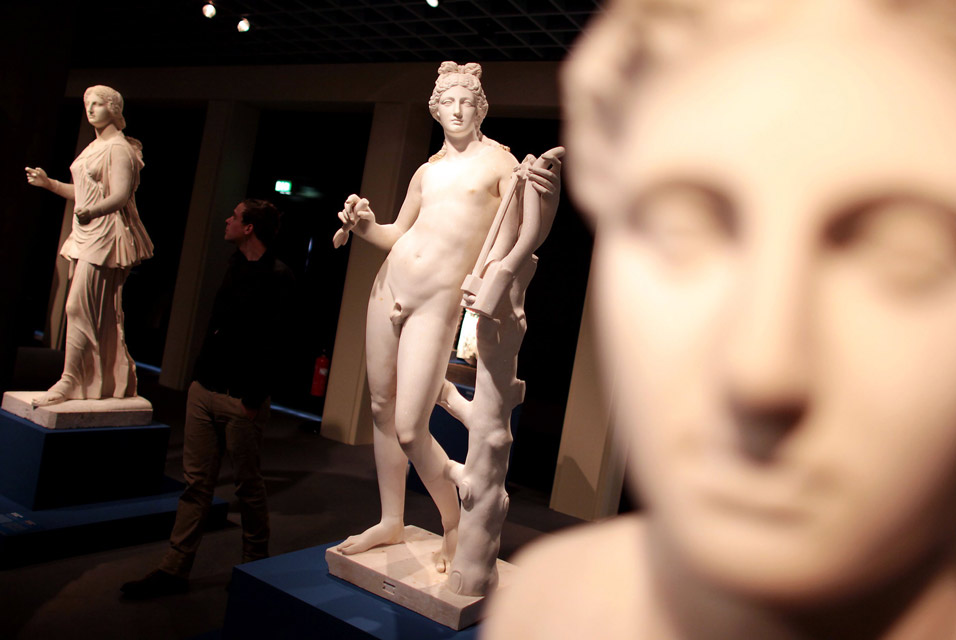
Olympian world of the Greek gods recreated

COLOGNE.- Even today, the world of the ancient Greek gods has lost none of its fascination. Accounts of the deeds of mighty Zeus, his jealous wife Hera, the twins Apollo and Artemis, beautiful Aph-rodite, and Dionysos the god of wine, are as enthralling as ever after more than 2000 years.
Greek poets and artists conveyed a vivid picture of the world of these gods. Their work set creative precedents and were a source of inspiration; they also furnished models and a stim-ulus for new interpretations and original compositions by Roman writers and sculptors.
Over a period of more than three hundred years, the Brandenburg-Prussian Electors and Kings in Berlin collected antique works of art, which are now in the museums of the ‘Preußischer Kulturbesitz’ Foundation – the Pergamon Museum and the Collection of Antiquities. For the first time in Cologne, in the exhibition The Return of the Gods, the Olympian world of the Greek gods is recreated with marble statues, stone reliefs, bronzes and luxurious vases from the Berlin collections – a cross section of outstanding European art from early Greek times to the imperial Roman period.

Zeus, Hades, Poseidon – the Father Gods
Zeus, the Romans’ Jupiter, was the majestic ruler of the Olympian world. As the lord of the heavens, he carried a thunderbolt as his weapon. Zeus was the father of nu-merous gods and heroes; most of his offspring were not begotten with his wife Hera, but were the result of his many erotic liaisons.
Poseidon was the master of the sea, inland waters and storms. As the “shaker of the Earth”, who made the Earth tremble with his trident, he was held responsible for earthquakes and natural disasters. People also venerated him as the protector of their ships. The Romans called this god Neptune.
Brother of Zeus and Poseidon was Hades, the Romans’ Pluto. He became the lord of the underworld when the gods drew lots to divide the world between them.
All these “Father Gods” are represented as mature, dignified and mighty. Zeus the father of the gods, Hades the ruler of the underworld and Poseidon the god of the sea, are difficult to tell apart when not depicted with their characteristic attributes

Asclepius, the Healing God
Asclepius was the god of medicine and healing. He was the son of Apollo and a mortal woman, so merely a demigod. He was nevertheless worshipped as a god but not regarded as one of the Olympian gods.
Asclepius’ place was among the people. He is represented in the likeness of a Greek citizen: bearded, wearing a robe and leaning on a staff. A snake is coiled around his staff and the staff (or rod) of Asclepius is still the traditional symbol of medicine.
Asclepius had many sanctuaries that attracted throngs of worshippers, where the sick sought cures through healing sleep (incubation). A centre of his cult developed at Epidaurus and another was located on the island of Kos. The physicians of Kos achieved great fame in the 5th century BC. The best known was Hippocrates and, even today, doctors swear the “Hippocratic Oath”.
The cult of Asclepius reached the western part of the Roman Empire in 293 BC when the Epidaurus sanctuary established a shrine to the Latinised Aesculapius on Rome’s Tiber Island.

Hera and Demeter – the Mothers
Hera, the Romans’ Juno, was the sister and spouse of Zeus. As the queen of the gods she watched over marriage and legitimate offspring. She therefore pursued the amorous escapades of her husband with jealous severity.
Demeter, Ceres for the Romans, was the goddess of the fertile earth, of grain and agriculture. According to the “Homeric” hymn to Demeter, her daughter Kore was abducted by Hades and, as Persephone/Proserpina, became his wife in the under-world. Searching for her daughter, the desperate Demeter neglected her responsibilities as the goddess of agriculture, which led to a severe drought. Only after the return of her daughter for two-thirds of the year did she allow everything to grow and flourish again, but Kore-Persephone had to spend one third of each year with Hades in the underworld, during which time nature was also dead.Demeter and Hera are usually depicted as motherly goddesses, often wearing a dia-dem and veil. When ears of wheat – a specific attribute of Demeter – are not shown, it is scarcely possible to distinguish between the two.

Aphrodite and Hermes
Aphrodite’s sphere of influence was love; her son Eros was the personified god of love. From the 5th century BC onwards, Aphrodite was depicted in ever more reveal-ing clothes: light and flimsy garments accentuated the beauty of the female body. Aphrodite first appeared completely naked in the 4th century BC, as a statue by Praxiteles, whose visualisation of the goddess was widely copied. Venus, the Roman equivalent of Aphrodite, was said to be the mother of Aeneas. Hence she became the mythical ancestress of the family of the Julii, to which both Caesar and Augustus belonged.Hermes was the messenger of the gods, the god of roads, boundaries and herds-men, the patron of thieves. He guided the souls of the dead into the after-world.Hermes wore the clothes of a traveller: a short cape, a broad-brimmed hat and boots or sandals. Speed was suggested by wings attached to his hat, shoes or heels. In addition, he carried a messenger’s staff with two snakes (Kerykeion). The Roman equivalent of Hermes was Mercury, the god of commerce and economic prosperity.

Athena – the Patroness of Great Works
Athena was the wise daughter of Zeus. Before his marriage to Hera, Zeus was the husband of Metis, the goddess of wisdom. Zeus then swallowed his consort when she was pregnant with Athena because it had been prophesied that she would bear him a child stronger than himself, who would ultimately depose him. Athena was born when Hephaestus, the blacksmith god, cleaved open her father’s skull.Athena was the goddess of battle, depicted with a helmet, lance and shield. Another emblem was the “aegis”, a breastplate with the head of the Gorgon Medusa in the centre. Athena was the patroness of the crafts and all artistic activities. She is also said to have invented the flute. While playing it beside a stream, she saw a reflection of herself with her cheeks puffed out, and crossly cast the instrument aside. The satyr Marsyas retrieved the flute and later challenged Apollo to a musical contest.Many cities invoked the protection of Athena, especially Athens, where she was worshipped on the Acropolis. Her Roman equivalent was Minerva.

Apollo and Artemis – divine twins
The twins Apollo and Artemis were the children of Zeus and Leto. Jealous Hera pur-sued her rival relentlessly until, finally, the island of Delos allowed Leto to give birth to her children there.Apollo was the upholder of order in human society, slaying wrongdoers with his bow and sending pestilence as a punishment. He defended religious purity. His attribute was the laurel. He was also the god of oracles and divine prophesies, leader of the muses and a master of the lyre. He was depicted as an idealized youth with long hair.Artemis, the goddess of the hunt and huntsmen, represented unspoiled nature. Known since ancient times as the “Mistress of the Animals” and the “unconquered virgin”, she nurtured and protected young animals, but was also a huntress who killed her prey. Since the late classical period, she has usually been depicted as a young girl in a hunting tunic with a bow and a quiver full of arrows, often accompanied by an animal. Just as her brother was both the god of healing and the god of pestilence, so Artemis was the goddess of childbirth and the bringer of death in childbirth.

The Sanctuary
In the Greek and Roman world, the sanctuary was the most important place for wor-shipping the gods. People would go there with votive offerings and gifts to praise or appease a deity and to ask for favours.
At larger ritual sites there were temples with a cult image of the god. However, the centre of the sanctuary was always the altar where sacrifices were offered. At public ceremonies, cattle were often sacrificed: the priests would burn the bones, fat and hide of the animal as an offering to the gods; the meat would then be consumed by the worshippers at a ritual feast. Individual citizens usually donated smaller animals, fruit or libations. The rites could be accompanied by processions, dancing and music.
An abundance of offerings of various types would accumulate at such sacred sites. Large objects like statues would be set up on display while smaller votive objects, such as miniature figurines or weapons captured from the enemy, were deposited somewhere. In large Greek sanctuaries, Olympia and Delphi for example, there were also treasuries where valuable offerings were stored.

Dionysus and the Theatre
Dionysus was the god of wine and delirious ecstasy. Those who gave themselves to this god had to risk becoming “possessed”. Dionysus was surrounded by a retinue (thiasos) of half-wild hybrid creatures, youthful satyrs, older sileni, and frenzied maenads who often danced to the music of flutes and drums.
Dionysus was depicted as child, as a seductive youth with a body that is sometimes rather feminine, and as an old man leaning on a satyr. His attributes were the ivy, either as a wreath to prevent intoxication or wound around a staff (thyrsos), and a drinking vessel (kantharos). He always symbolised a hedonistic way of life.
Greek theatre originated in the cult of Dionysus. In many places of worship, dramatic performances were part of his festivals. Starting in Athens in the 6th century BC, first tragedies, then “satyr” plays and – after 486 BC – comedies were performed during the Great Dionysia festival. All the roles in the plays, even female roles, were taken by three male actors wearing costumes and masks, accompanied by a choir.

The Pergamon Altar
In the conflicts to succeed Alexander the Great, Philhetairos was able to establish his rule in Asia Minor, at Pergamon. His grandson, Attalos I, took the title of King. The latter’s son, Eumenes II (197-159 BC), defeated the invading Celts and developed the fortress into a Hellenistic city with prestigious marble buildings.The religious centre was the altar of Zeus, which was visible from afar. A flight of steps led up to a podium and the colonnaded area with the altar for burnt offerings. The podium was decorated on all sides by a frieze depicting the battle of the gods against the giants. The rear walls illustrated the history of the founding of Pergamon. Acroteria with figures stood on the roof.
The gigantomachy on the Pergamon Altar marks the pinnacle of Hellenistic art. It is the most complete antique depiction of the struggle of the younger generation of Olympian gods, together with Hercules, against the giants, born out of chaos, who were trying to destroy the new world order. Zeus with his lightning bolts is shown fighting a snake-footed giant, an allusion to the victory over the Celts

Δευτέρα 21 Μαΐου 2012

Ancient Greek Music

The music of ancient Greece was almost universally present in society, from marriages and funerals to religious ceremonies, theatre, folk music and the ballad-like reciting of epic poetry. It thus played an integral role in the lives of ancient Greeks. There are significant fragments of actual Greek musical notation.as well as many literary references to ancient Greek music, such that some things can be known—or reasonably surmised—about what the music sounded like, the general role of music in society, the economics of music, the importance of a professional caste of musicians, etc. Even archaeological remains reveal an abundance of depictions on ceramics, for example, of music being performed. The word music comes from the Muses, the daughters of Zeus and patron goddesses of creative and intellectual endeavours.Our knowledge of Greek music comes from several sources, as a number of musical scores and the remains of various instruments survive.Abundant ancient literary references, mostly of a nontechnical nature, shed light on the practice of music, its social functions, and its perceived aesthetic qualities.Inscriptions provide information about the economics and institutional organization of professional musicians, recording such things as prizes awarded and fees paid for services.Archaeological evidence gives some indication of the contexts in which music was performed and of the monuments that were erected in honor of accomplished musicians. In Athens during the second half of the fifth century BC., a splendid roofed concert hall known as the Odeion of Perikles was erected on the south slope of the Athenian akropolis—physical testimony to the importance of music in Athenian culture. The musical subjects frequently depicted in painting and sculpture give valuable information about how instruments were played and the settings in which they were used.

At a certain point, Plato complained about the new music:
Our music was once divided into its proper forms...It was not permitted to exchange the melodic styles of these established forms and others. Knowledge and informed judgment penalized disobedience. There were no whistles, unmusical mob-noises, or clapping for applause. The rule was to listen silently and learn; boys, teachers, and the crowd were kept in order by threat of the stick. . . . But later, an unmusical anarchy was led by poets who had natural talent, but were ignorant of the laws of music...Through foolishness they deceived themselves into thinking that there was no right or wrong way in music, that it was to be judged good or bad by the pleasure it gave. By their works and their theories they infected the masses with the presumption to think themselves adequate judges. So our theatres, once silent, grew vocal, and aristocracy of music gave way to a pernicious theatrocracy...the criterion was not music, but a reputation for promiscuous cleverness and a spirit of law-breaking.

From his references to "established forms" and "laws of music" we can assume that at least some of the formality of the Pythagorean system of harmonics and consonance had taken hold of Greek music, at least as it was performed by professional musicians in public, and that Plato was complaining about the falling away from such principles into a "spirit of law-breaking".
Playing what "sounded good" violated the established ethos of modes that the Greeks had developed by the time of Plato: a complex system of relating certain emotional and spiritual characteristics to certain modes (scales). The names for the various modes derived from the names of Greek tribes and peoples, the temperament and emotions of which were said to be characterized by the unique sound of each mode. Thus, Dorian modes were "harsh", Phrygian modes "sensual", and so forth. In his Republic, Plato talks about the proper use of various modes, the Dorian, Phrygian, Lydian, etc. It is difficult for the modern listener to relate to that concept of ethos in music except by comparing our own perceptions that a minor scale is used for melancholy and a major scale for virtually everything else, from happy to heroic music. (Today, one might look at the system of scales known as ragas in India for a better comparison, a system that prescribes certain scales for the morning, others for the evening, and so on.)

The sounds of scales vary depending on the placement of tones. Modern Western scales use the placement of whole tones, such as C to D on a modern piano keyboard, and half tones, such as C to C-sharp, but not quarter-tones ("in the cracks" on a modern keyboard) at all. This limit on tone types creates relatively few kinds of scales in modern Western music compared to that of the Greeks, who used the placement of whole-tones, half-tones, and even quarter-tones (or still smaller intervals) to develop a large repertoire of scales, each with a unique ethos. The Greek concepts of scales (including the names) found its way into later Roman music and then the European Middle Ages to the extent that one can find references to, for example, a "Lydian church mode", although name is simply a historical reference with no relationship to the original
From the descriptions that have come down to us through the writings of those such as Plato, Aristoxenus and, later, Boethius, we can say with some caution that the ancient Greeks, at least before Plato, heard music that was primarily monophonic; that is, music built on single melodies based on a system of modes/scales, themselves built on the concept that notes should be placed between consonant intervals. It is a commonplace of musicology to say that harmony, in the sense of a developed system of composition, in which many tones at once contribute to the listener's expectation of resolution, was invented in the European Middle Ages and that ancient cultures had no developed system of harmony—that is, for example, playing the third and seventh above the dominant, in order to create the expectation for the listener that the tritone will resolve to the third.

Yet, it is obvious from the following excerpt from Plato's Republic that Greek musicians sometimes played more than one note at a time, although this was apparently considered an advanced technique. The Orestes fragment of Euripides seems to clearly call for more than one note to be sounded at once.. There is also intriguing researce in the field of music from the ancient Mediterranean—decipherings of cuneiform music script—that argue for the sounding of different pitches simultaneously and for the theoretical recognition of a "scale" many centuries before the Greeks learned to write, which of course would have been before they developed their system for notating music and recorded the written evidence for simultaneous tones. All we can say from the available evidence is that, while Greek musicians clearly employed the technique of sounding more than one note at the same time, the most basic, common texture of Greek music was monophonic.
That much seems evident from another passage from Plato:
...The lyre should be used together with the voices...the player and the pupil producing note for note in unison, Heterophony and embroidery by the lyre--the strings throwing out melodic lines different from the melodia which the poet composed; crowded notes where his are sparse, quick time to his slow...and similarly all sorts of rhythmic complications against the voices--none of this should be imposed upon pupils...

Music was essential to the pattern and texture of Greek life. Certain Greek philosophers saw a relationship between music and mathematics, and envisioned music as a paradigm of harmonious order, reflecting the cosmos and the human soul.Although the Greeks knew many kinds of instruments,they used two above all: lyres and auloi (pipes). Most Greek citizens were trained to play an instrument competently, and to sing and perform choral dances. Instrumental music or the singing of a hymn regularly accompanied everyday activities and formal acts of worship. Shepherds piped to their flocks, oarsmen and infantry kept time to music, and women made music at home. Musicians performed in contests, at the drinking parties known as symposia, and in the theater.The art of singing to one’s own stringed accompaniment was highly developed. However, despite the wealth of circumstantial evidence, the sounds of ancient Greek music are lost to us

Παρασκευή 11 Μαΐου 2012

Poseidon the Greek God of the Sea

One of the twelve great Olympian gods, Poseidon was the Greek god of the sea whose fearsome rage could bring violent storms and earthquakes on the world. Homer calls him ''Earth-holder'' and as lord of earthquakes,Earth-shaker. He vividly depicts the mighty god as he journeys across his territory {Iliad 13.23-30): He harnessed to his chariot his two bronze-shod horses, swift of foot,with long, streaming manes of gold. Himself clothed in gold, he seized his well-wrought golden whip, then climbing into his chariot he drove across the waves. On every side, from the deeps of the sea, came dolphins,playing in his path, acknowledging their lord, and the sea parted in joy, cleaving a path before him. So swiftly sped the horses that never once was the axle of bronze beneath made wet with foam.

Poseidon was one of the six children of the Titans Cronus and Rhea, swallowed and later regurgitated by his cannibalistic father.When Cronus had been defeated and his three sons divided the universe among themselves, they kept the earth and Olympus as common property, while Zeus took the heavens as his domain, Hades the misty darkness of the Underworld, and Poseidon the seas. According to Homer, there was a time when Poseidon rebelled, conspiring with Hera and Athena to put Zeus in chains. But the sea-goddess Thetis saved him, sending Briareos  to release him.Poseidon vied with Apollo for the love of Hestia, the goddess of the hearth, but she rejected both of them, swearing a vow of eternal chastity. He also vied with Zeus for the love of Thetis, but both gods withdrew their suit when they learnt that she was destined to bear a son mightier than his father. Poseidon's wooing of the Nereid Amphitrite came to a happier conclusion: with the help of a dolphin,who found her when she fled into hiding, he won her for his wife.With her he lived in a splendid golden palace in the depths of the sea. She bore him a son, the merman Triton, and two daughters, Rhode and Benthesicyme. But Poseidon was one of the most prolific of the gods and fathered numerous children on many mistresses. He himself could be violent and vindictive, and some of his sons inherited his dangerous nature, such as the evil Sciron, Sinis and Cercyon,all killed by Theseus; the boxer Amycus, killed by Polydeuces;and the Egyptian king Busiris, killed by Heracles.Some of his formidable offspring were giants, such as the Siamese twins, the Moliones;Otus and Ephialtes, who attempted to take over Olympus;the wrestler Antaeus, who was killed by Heracles; the great hunter Orion; Lamus, who founded the Laestrygonians, a race of maneating giants; and perhaps best-known of all, the Cyclops Polyphemus, who was blinded by Odysseus.

Others of Poseidon's more famous children were the twins Pelias and Neius, whom he fathered on Tyro, taking the shape of the rivergod Enipeus; Libya's three sons, Belus, Agenor and Lelex; Eumolpus,the son of Chione(, who was thrown into the sea by his mother and reared by Poseidon's daughter Benthesicyme; the navigator Nauplius, fathered on the Danaid Amymone while she was hunting for water in Argos; Hippothoon, the son of Alope, who was suckled by a mare and reared by shepherds after Alope was cruelly killed by her father; and of course the great Athenian hero, Theseus, borne to Poseidon by Aethra.
Poseidon was also the god of horses, and in this guise was known as Poseidon Hippios, 'Horse Poseidon'. As a horse he mated with the goddess Demeter, who bore him the divine horse, Areion, and a daughter, Despoina. Medusa was pregnant by him when she was killed by Perseus, and from her severed neck were born the winged horse, Pegasus, and Chrysaor. Poseidon presented wondrous horses to favoured mortals, both to Pelops, to help him win the hand of Hippodameia, and to his son Idas, to help him win the hand of Marpessa. To Peleus he gave as a wedding present the immortal horses Xanthus and Balius, who were later taken by Achilles to fight at Troy. The god showed his favour to other mortals in rather different ways. He made love to Caenis while she was wandering alone on the seashore, then at her own request turned her into a man, Caeneus,and made her invulnerable. He also made his son Cycnus invulnerable, and on his death at Achilles' hands turned him into a swan.He gave to his mistress Mestra, daughter of Erysichtheon, and to his grandson Periclymenus the ability to change their shape at will.Like other sea-deities, Poseidon himself had the power of changing his own shape. He came to Theophane as a ram, and fathered on her the flying, talking ram with the golden fleece which saved Phrixus and Helle from their wicked stepmother Ino, and which later became the motive for the long and arduous journey of Jason and the Argonauts.According to Ovid, Poseidon coupled with Canace, the daughter of Aeolus, as a bull, with Melantho, the daughter of Deucalion,as a dolphin, and with the Gorgon Medusa as a bird.Being a mighty and formidable god,Poseidon sternly punished the mortals who offended him. He was furious with Odysseus for blinding the Cyclops Polyphemus and kept him away from his homeland of Ithaca for many long, weary years; and he punished the Phaeacians, the people of Scheria, for helping Odysseus on his journey.

When Laomedon, king of Troy, refused to pay Poseidon and Apollo the agreed wage for building his city walls, the sea-god sent a sea-monster against the land, which would have devoured Hesione,Laomedon's daughter, had she not been saved by Heracles. Laomedon's offence was the reason for Poseidon's resentment of the Trojans and his support for the Greeks during the Trojan War. He frequently intervened to help his favourites, even against the express command of Zeus. This did not stop him helping Athena to punish the Greeks at the end of the war for the rape of the Trojan prophetess Cassandra by Ajax the sea-god sent violent storms that wrecked the Greek fleet off Cape Caphareus and brought death to many, including Ajax himself.At the Nereid's request, Poseidon sent another sea-monster against the Ethiopians, to punish a vain boast made by their queen, Cassiopeia.This time the monster's victim was to be the queen's daughter, Andromeda, but she was saved by Perseus. Poseidon was also associated with bulls: he brought death to Hippolytus, at the request of his father Theseus, by sending a bull from the sea that caused his horses to bolt and overturn his chariot. He sent as a gift to Minos, king of Crete, a magnificent white bull from the sea, then punished the king for failing to sacrifice it by inflicting on his wife,Pasiphae, a passion for the bull that led to the birth of the Minotaur.Poseidon came into conflict with some of the other gods over the
patronship of certain lands. He and Athena contested the possession of Attica during the reign of Cecrops. Both demonstrated their divine powers, Poseidon by creating a well of sea-water on the Acropolis of Athens, Athena by planting an olive tree. Athena's was judged the greater benefit, so the land became hers. Poseidon in anger sent a flood to cover Attica. He also quarrelled with Hera over the possession of Argos. The river-gods Inachus, Cephissus and Asterion judged the dispute in favour of Hera, and Poseidon, angry once again, dried up their waters. He was more fortunate in the case of Corinth,which he disputed with the Sun-god, Helios. The Hundred-hander Briareos was called in as arbitrator, and he awarded the citadel of
Acrocorinth to Helios and the Isthmus to Poseidon.

Poseidon was worshipped throughout the Greek world and from very early times: his name occurs on Mycenean Linear B tablets more frequently than that of any other divinity. At Rome he was identified
with the sea-god Neptune. He is a popular subject in ancient art, easily recognised by his most famous attribute, the trident, though he sometimes holds a fish and is often accompanied by sea creatures.
Occasionally he rides a hippocamp (a hybrid with the foreparts of a horse and the tail of a fish). Popular too in postclassical art, he figures prominently in sea-triumphs with his wife Amphitrite and is a natural subject for fountain-figures, such as on the famous Trevi Fountain at Rome. His marble temple on the promontory of Sounion in Attica, built in the late fifth century BC, is still a landmark for sailors.

Πέμπτη 10 Μαΐου 2012

The Nature of the Greek Gods


Amongst the many creations of Greek culture, the Olympian gods have a particular interest. As with anything in the ancient world, we have various types of information about them. Some comes from archaeology, some from texts, some concerns history, some concerns thought. But whereas the great sanctuary of Apollo at Delphi was,and is, real, and we discover about the same sanctuary from our various sources of information, it is different with the individual gods. The ancient gods are not real – at least, that is the general supposition – and what our evidence leads us to is pictures that peoples created in their minds and shared in their imaginations. The gods are in fact the most powerful work of art created by the Greeks. And they live in different,but intersecting, dimensions, which combine to create the illusion of a single personality.
The primary dimension is that of cult (religious practice). Greeks prayed, sacrificed,poured libations, held festivals, demarcated places which would be precincts, built altars and temples, gave gifts and built ‘‘treasuries’’ to hold them all. In doing all this they represented themselves as performing acts to, for, or at least with an audience of, gods. It is far from unusual to have many gods (‘‘polytheism’’) or to think of them somehow as persons. But by the standards of other nations, Greek gods were exceptionally anthropomorphic – they were ‘‘shaped like people.’’ The focus of Greek worship tended not to be mighty stones or trees (‘‘aniconic,’’ non-representational, objects of worship), though they admired those too, but stone or wood shaped into statues of personal gods. Each god was an individual person and each was thought of as having their particular identity.Different Greek cities or ethne¯ (peoples who were not yet urbanized) worshiped broadly similar gods to each other. But the system was far from uniform and the Zeus
imagined in one place might be rather different from the Zeus imagined in another.Indeed, in a single place you might worship a variety of Zeuses, distinguished by their epithets – so Zeus ‘‘Meilichios,’’ Zeus the dangerous but hopefully ‘‘gentle,’’ is a different business from Zeus ‘‘Olympios,’’ the Zeus who is king of the gods on Mount Olympus. Each Olympian god is particularized by epithets, which are a bit of  compromise: they maintain a single identity (of Zeus), but diffract it into a rich spectrum of locations, functions, and traditions.
The second dimension is that of mythology. Myths might be local and might present for instance a supposed reason for a current religious practice, when they are described as ‘‘aetiological.’’ This would not be an actual, historical reason, because myths are no more true than gods are real. They are a way of thinking about the world around us and the people in it. It is in the nature of the worship of the Greek gods to generate myths,and it is in the nature of poets, the entertainers of Greek culture, to collect them and
synthesize them into a compromise set of stories that develop shared ideas of what the gods are like and how they behave. The principal Greek myths are widely known in ancient Greece and find their place in epics, lyric poetry, drama, and all manner of cultural production. They are everywhere in Greek art too.
The third dimension is that of thought about gods and the divine, ‘‘theology.’’ But Greece did not have official theologians: what it had was poets, philosophers, and anyone else who was prepared to think. Here finally we may worry about how the universe is run and speculate on the justice or the goodness of the gods. It is at this point that personal gods have their weakest grip and abstraction sets in most easily.So, to take the major cult site of Zeus in the Peloponnese, the huge temple of Zeus at Olympia (built for cult, decorated with  myth) provokes reflection on his power (theology). The ceremonies and celebrations enact that power with grandeur and significance, and in so doing focus something of Greek identity onto this site. This happens explicitly once every four years and implicitly, through memory and monuments, at all times in between, as this is always the place that carries the history of the ritual and its apparently limitless future. The huge altar of ashes grows with this year’s offerings; and the animals sacrificed in large number to the god, awesomely struck down and wailed over, give their lifeblood not to us but (back) to the god. This is the ‘‘same’’ Zeus whom Homer celebrates in the Iliad, mighty, remote, never actually walking the earth, distributing human happiness and misery, deciding the end of everything, including us. But he also behaves in ways that are harder to understand: he is said to have flung the god Hephaestus from heaven to land on Lemnos where the worship of the god of fire can take place; he argues with his wife (for why else should their marriage need to be renewed annually?); he is seduced by her on Mount Ida, in a scene presented rather daringly or wickedly by the poet. 
At Olympia we will also look forward to the traditional ritual song celebrating his thunderbolt, and we will think, as we look to the sky in prayer, about that great being whose justice is so hard to grasp, as Aeschylus showed us in his last plays – the Agamemnon and the Prometheus Bound (if it is by him). And as we look at the temple’s sculptures, we see a mythology surrounding Zeus – a pediment showing the chariot race of Pelops for the hand of Hippodameia, a pediment displaying Zeus’s son Apollo bringing order to Centaurs and Lapiths, and the metopes displaying the work of another of his sons,Heracles, founder of the Olympic Games, namely his twelve labors to civilize the world and overcome the adversity that Zeus’s wife Hera had put in his path. Zeus himself once again is mysteriously absent from these scenes, but we may reflect upon
his world order and then enter the temple to see what came to be one of the seven wonders of the ancient world, the huge enthroned Zeus by Pheidias, a statue which changed the path of Greek art.Greek gods may not be neatly packaged, but that helps them to provoke thought as we bring together ideas from all the different places where we encounter them –participating in cult, watching cult, seeing the myth depicted, hearing it acted out,listening to it sung. You could only emerge humbled from the experience of Zeus.

Τρίτη 1 Μαΐου 2012

The Religious and Moral Ideas of Aeschylus

The great problems of religion and morals, and of man's destiny and the government of the universe, enter so largely into the composition of the tragedies of Aeschylus, that in order to appreciate their full significance it is necessary to acquire some general notion of his views on these questions and of the ideas which he desired to inculcate. In the case of a modern dramatist the attempt to extract such information from his works might be hazardous and misleading, owing to the difficulty of discriminating between the real sentiments of the poet himself, and the opinions which were merely placed, for dramatic purposes, in the mouths of his characters. But in Aeschylus there is no such difficulty to be encountered. His choral odes, like those of most of the ancient tragic poets, are composed with the express purpose of enforcing his own ideas, and pointing the moral of the tragedy. Moreover, in many places the sentiments of the dialogue are obviously those of the poet; and the very substance of the plots is often of such a character as to place his opinions in the clearest light.The sixth century [B.C.], in which Aeschylus passed his early years, was one of great stir and movement in matters of religion and speculation. The old theogonies of Homer and Hesiod, with their primitive morality and simple conception of the gods, had long since failed to satisfy the higher minds among the nation. The prevalence of deeper aspirations and a more searching curiosity is proved by many symptoms. Associations such as the Orphic societies and the Pythagorean brotherhoods, with their ascetic rules of life and their doctrines of immortality, began about this time to acquire their widespread popularity. The mysticism of Pherecydes, the pantheistic dreams of Xenophanes, and the cosmic speculations of Thales and Anaximander, are equally typical of the new spirit of the age. All these various tendencies, philosophical and religious, must have had their influence in forming the opinions of Aeschylus; and Cicero goes so far as to call him a Pythagorean. But the exact extent of the debt which he owed to his predecessors cannot any longer be determined, owing to our fragmentary knowledge of the doctrines of the sixth century. We must content ourselves, therefore, with the mere exposition of his views, as they appear in his tragedies, without endeavouring to discriminate between what was due to his own genius and what was derived from other sources.

The work which Aeschylus set himself to perform, as a moral teacher, was to reconcile the popular religion with the more advanced conceptions of his time, by purifying its grossness and harmonizing its various inconsistencies. In this attempt he was more successful than might have been expected. The primitive legends, remodelled and reilluminated by his genius, acquire ... an unwonted grandeur and impressiveness. But the task was one of insuperable difficulty. The old Greek mythology, with its medley of beauties and monstrosities, and of graceful fancies and coarse brutalities, hardly admitted of being systemized into a perfect whole. It was impossible, therefore, that Aeschylus, in endeavouring to accomplish this result, should avoid occasional incongruities, or that the scheme expounded in his writings should be complete and symmetrical in all its parts. Few, however, will deny that in his hands the religion of the Greeks has been raised to a higher level of moral dignity than it ever attained either before or since.The first point to be noticed, in regard to his religious views, is the sublime conception of Zeus as the supreme ruler of the universe. The other deities are represented as merely the ministers of his will, and though still possessing their usual characteristics, stand in subordinate rank. The language applied to Zeus is monotheistic in tone, and his praises are chanted in strains of the loftiest exaltation. He is "king of kings, most blessed of the blessed, most mighty of rulers." His power "knows no superior, nor is any one enthroned above him; swifter than speech is the accomplishment of his purpose." He "holds for ever the balance of the scales: nothing comes to mortal man but by the will of Zeus." "Zeus is sky, and earth, and heaven; Zeus is all things, yea, greater than all things." His power, though invisible, is omnipotent and omnipresent. "Dark and shadowy," it is said, "are the pathways of his counsels, and difficult to see. From their high-towering hopes he hurleth down to destruction the race of men. Yet setteth he no forces in array, all his works are effortless. Seated on holiest throne, from thence, unknown to us, he bringeth his will to pass."

This noble conception of Zeus, it cannot be denied, is scarcely consistent with the character which he bears in Greek mythology, or with the actions which he sometimes performs even in Aeschylus himself. Hence some critics have been led to imagine that there is in Aeschylus a double Zeus -- the ordinary god of the polytheistic religion, and the one omnipotent deity in whom he really believed. They suppose that he had no genuine faith in the credibility of the popular legends, but merely used them as a setting for his tragedies; and that his own convictions were of a more philosophical type, and are seen occasionally in such passages as those above quoted.This theory, however, though not without a certain plausibility, is open to serious objections. In the first place it seems to be most improbable that there was any clear distinction in the mind of Aeschylus between the Zeus of the legends, and the higher Zeus of his own imagination. In his descriptions of the deity the loftiest conceptions are closely intermingled with fabulous traditions. Though Zeus is invoked as "king of kings, and mightiest of rulers," he appears in the very next lines as "lover of Io and ancestor of Danaus." While addressed in glowing language as the lord of the universe, he is entitled at the same time successor of Uranus and Cronus. Inconsistencies of this kind were the natural result of the endeavour to reconcile legend with philosophy.Further than this, the general impression produced by the plays of Aeschylus is unfavourable to the supposition that he was simply using the old legends for poetical purposes. The earnestness with which he inculcates reverence towards the gods of tradition, and the anxiety which he shows to remove all stumbling-blocks from the old mythology, seem inconsistent with the indifference of a skeptic. Not that we are bound to assume, on his account, that he accepted with unhesitating faith the whole circle of the legends. Much, no doubt, he regarded as uncertain, much as false. Even the name "Zeus" was to him a mere convention. Like Pindar, he felt himself at liberty to reject what was hateful and improbable. But the ancient mythical gods were more to him than mere types and abstractions; and though their names might be uncertain, and their deeds distorted by tradition, he seems to have felt no doubt in his heart that they were real and potent divinities.

Zeus, then, in the conception of Aeschylus, is the ruler of all created things. But he is not a capricious monarch, swayed by casual passions, like the Zeus of Homer. To act with injustice is impossible to him; he is "constrained" never to assist transgressors. There is a universal law of justice, a moral ordinance governing the whole world, to which even he must submit. This law is called by different names -- Fate, Destiny, Justice, Necessity; but under these various terms the same all-embracing rule is denoted, as many passages will prove. Thus Fate is said to "whet the blade of Justice"; Destiny "forges for Justice her sword"; the Fates "guide the helm of Necessity." The special instruments by which, in the case of the more heinous offences, this law of strict justice is enforced are the Furies, the daughters of the Night. These dread goddesses of the underworld, in whom the spirit of vengeance is personified, derive their functions from Fate; whence they are called, in mythical fashion, the sisters of the Fates. Their mission is to pursue criminals, and crush them with misery and misfortune. Their aspect is loathsome and horrible, so as to strike terror into the guilty soul.
But while the Furies are the subordinate instruments of vengeance, the general administration of the laws of Justice and Destiny is in the hands of Zeus. This point is clearly emphasized by Aeschylus. It is Zeus who sends the Furies on their errands. Justice is the virgin daughter of Zeus. Zeus "guides by ancient rule the courses of Destiny." No man can "escape from Destiny, or transgress the mighty inexorable will of Zeus." The chorus of the Choephori implore "the all-powerful Fates to accomplish, with the aid of Zeus, the ends of Justice." The function, then, of Zeus, as omnipotent ruler, is to govern the world in accordance with that law of Justice which has been ordained by Fate and Necessity as the established order of the universe. It is true that in the Prometheus his position is represented in a somewhat different light, and that he is there depicted as subject to the decrees of Fate, and ignorant of their tenour. But the description of Zeus, as given in the Prometheus, is altogether exceptional in this as well as in other respects.

The relation between Zeus and the Furies, as the administrators of justice, deserves more special notice. The Furies, and the gods of the underworld generally, belong to an earlier order of deities, and represent that inexorable spirit of justice which executes to the full the strict letter of the law, regardless of other considerations. They are relentless and incapable of compassion. Zeus and the Olympian gods, on the other hand, are of more recent origin, and their character is less severe, the justice which they administer being tempered with equity. The supremacy of Zeus, therefore, denotes the supremacy of the spirit over the letter, and of equity over law; and it is the constant object of Aeschylus to reconcile these two opposing forces, and to explain away the stories of conflict between the gods of Olympus and the gods of the underworld; to show, in other words, that the system of the universe is harmonious and consistent in all its parts.Such being the scheme of divine government, as conceived by Aeschylus, in which the laws of eternal justice are administered by an all-powerful deity, it follows that injustice can never prosper, and that the punishment of sin is certain and inevitable. This doctrine was not a new one among the Greeks; it appears in Homer and Hesiod, and other poets of an early date. But there is no Greek writer by whom it is brought forward with such persistency, and emphasized with such vigour and intensity, as by Aeschylus. It forms the basis of all his dramas. The inexorable character of the divine justice, and the certainty of the retribution which follows crime, are themes on which he is never weary of dilating, with an energy and splendour of diction which recall the utterances of the Hebrew prophets. "Impious," he says, "are the thoughts of those who declare that the gods pay no heed to the sins of evil-doers." "As long as Zeus remains seated on his throne, the wicked shall suffer." "Whosoever commits all manner of transgressions, and swerves from right, he perforce in time shall lower sail, when trouble has overtaken him, and his yard-arms are breaking. Then he calls in his trouble to those who heed him not, and strives in vain amid the surge. And God laughs at the man of fiery heart, who boasted that no evil should come nigh him, when he sees him worn with inextricable woes, and ever failing to round the perilous promontory. And he perishes for ever, unwept, unseen, wrecking his former bliss on the shoals of justice."

Nor is the punishment of crime confined to the person of the criminal; the vengeance of heaven extends still further, and falls upon innocent victims, visiting the sins of the father upon the children even to distant generations. When guilt has been once incurred, a curse descends upon the family of the offender, and infects it with an hereditary taint. An Avenging Spirit is ever on the watch, and drives it on to fresh acts of wickedness. One crime begets another, until the history of the race becomes a long record of evil and disastrous deeds.This notion of an ancestral curse, which expresses in mythological form the belief in the remote and incalculable effects of sin, was likewise one of great antiquity among the Greeks, and was embodied in many of their ancient legends. It is employed by Aeschylus as the groundwork of several of his extant tragedies; and the mysterious working of the curse, as it descends from father to son, and blights the happiness of one generation after another, is painted in dark and terrible colours. A doctrine of this kind ... if pushed to extremes, could only end in fatalism and despair; and it has often been supposed that such is in reality the creed of Aeschylus, and that mankind are represented in his tragedies as the sport of a blind and capricious Destiny, which sweeps innocent and guilty into the same net. But Aeschylus had far too profound a conviction of the justice of Providence to acquiesce in dogmas of such a hopeless character. He is careful to warn us against this very conclusion, and to soften and modify the fatalistic rigour of the old belief. While recognizing the baneful effects of sin even upon remote victims, he never doubts the freedom of man's will, or his power to avert calamity by keeping his hands free from evil. When a curse is upon a family, it predisposes them to crime; but there is no actual compulsion. It is their own vicious inclinations, combining with the promptings of the Avenging Spirit, which bring the curse into operation, and cause the evil to be perpetrated. This point is clearly brought forward in the conversation between Clytemnestra and the chorus, after the murder of Agamemnon. Clytemnestra pleads that it is not she, but the Avenger, that has done the deed. The chorus reject the plea with indignation. "Who," thez reply, "will bear witness that thou art guiltless of this murder? Yet the Avenger might help thee to accomplish it."

In this reflection of the chorus we have a definite statement of the opinion of Aeschylus, that the effect of hereditary guilt in a family was not so irresistible as to crush the free-will of its members, or to absolve them from responsibility. The same truth is enforced in the plots of his tragedies. There is a curse upon the house of Oedipus, which eventually leads the two brothers, Eteocles and Polyneices, to their ruin. But they are neither of them guiltless; they bring the curse upon themselves through their own conduct, the one allowing his better judgement to be overborne by fraternal hatred, the other waging impious war against his native country. So too with the house of Atreus. Clytemnestra is an adulteress, and Agamemnon sacrifices the life of his daughter for ambitious purposes. Orestes alone is pure in his motives, and when he slays his mother, performs the deed as an act of strict justice, after long hesitation, at the express bidding of the oracle. Hence in his person the curse is expiated, and the family henceforth relieved from its calamities.It is only guilt, therefore, which is punished by heaven; innocence and justice, on the other hand, are protected and rewarded. "Zeus inclines the scales on either side, sending evil to the wicked, good to the just." The Furies "visit not the man of clean hands; he passes his life unscathed." The old Greek opinion, that the gods look with envy upon the good fortune of men, and delight in visiting excessive prosperity with reverses, apart from the question of guilt or innocence, is expressly repudiated by Aeschylus. "It is an old saying," he declares, "that much prosperity begets misfortune. I hold a creed apart from this. It is the impious deed which brings forth an offspring of woe, like its parent stock. But the house that loves justice shall flourish from generation to generation." Yet he admits that wealth and prosperity are dangerous, often leading men into insolence and pride. From pride comes delusion, "the black irresistible deity," and takes possession of the soul, uprooting the moral sense, and alluring the victim with seductive wiles into the meshes of calamity. For such a man the only remedy is the discipline of adversity, which may restore him to a better frame of mind. For Zeus has appointed that "suffering should bring instruction," and it is "a good thing to be taught wisdom by misfortune."

Lastly, as to the question of a future state. In the time of Aeschylus the old Homeric conception of the obscure and comfortless existence of the soul after death had been expanded, by the teachers of the Orphic school, into a definite creed concerning a future world of rewards and punishments. But this belief was confined to the sects of the initiated, and never appears to have formed a part of the ordinary Greek religion. Aeschylus, indeed, refers to it on three or four occasions, but only in partial and incomplete manner. He holds out no prospect of future reward to the virtuous, all the blessings which he promises being confined to the present existence. His punishments, too, are mostly of the same kind; and though he sometimes speaks of the dead as still exposed to torment, yet in one of these places he mentions the belief as a report current among mankind, rather than as a conviction of his own. Otherwise his description of the souls of the departed is in accordance with the ordinary superstition. There existence is still dark and shadowy, as in Homer, and the feeling by which they are chiefly animated is a craving for vengeance upon those who may have injured them on earth. Thus Clytemnestra is taunted by the other inhabitants of Hades because her murder is still unexpiated; and the chorus remind Orestes that "the ravenous jaws of the funeral fire consume not the spirit of the dead," but that he still cries for vengeance from beneath the ground. Even this dim belief in a future state may have been introduced from dramatic necessity, and as forming an integral part of the legend, rather than from personal conviction; since in one of his fragments he enunciates the opinion that all things are indifferent to the dead, and that they feel neither pleasure nor pain.

Δευτέρα 30 Απριλίου 2012

Orphism an Ascetic rule of life

Historically the cult most nearly related to that of Dionysus was the philosophico-religious system bearing the name of Orpheus. It is not possible to pronounce with certainty whether such a man as Orpheus ever really existed or not. He may have been a purely mythical figure. If he was a real man he was a religious leader of mark and deserving of admiration: a prophet, reformer, and martyr. Whether mythical or real, Orpheus was the antitype of the flushed and maddening wine-god Dionysus. He was a sober and gentle musician who charmed savage men and beasts with his music, an exact theologian, the prophet of reform in religion, who was martyred for his efforts.The difference between Dionysus and Orpheus was the difference between the two religious systems which bore their names. The cult of Dionysus was more simple, primitive, elemental, spontaneous, and emotional. That of Orpheus was more elaborate, developed, controlled, and intellectualistic. Still, when all is said, the two systems had much in common. Both centered in the same god, Dionysus. Both aimed at the same goal, immortality through divinity. Both sought to attain that goal by prescribed rites and ceremonies. Both made a strictly individualistic appeal and were highly developed along the lines of personal experience. But Orphism fostered an ascetic rule of life that was the exact opposite of Dionysian license, and developed an elaborate theology of a highly speculative character. In brief, Orphism represented a reformed Dionysianism, and the practices it could not or did not reform it sought to explain and justify by its mythology.

Our sources of information concerning the Orphic movement are unusually authoritative and accessible. They include chiefly a reputable group of classical writers together with a singular collection of Orphic tablets found in south Italy and Crete. The list of classical witnesses to the Orphic cult is headed by the name of Pindar. In his "Dirges," or choral lyrics intended to be chanted at funerals, he offered consolation to mourners by telling them of the Orplic promise of immortality. He further detailed the Orphic doctrine of reincarnation which he represented as a scheme of preliminary purgation by means of triple earthly lives, preceding the final bliss. Again he described with pleasing detail the delights of the Elysian land where the final beatification was to be realized, and in the second Olympian Ode he told of the future of the wicked as well as of the pure. Another important classical witness to Orphism was Plato. Though affecting to despise the system, he was actually much influenced by it. In Cratylus, for example, he made use of the characteristic Orphic idea of the body as a prison house of the soul (soma-sema). In the Republic he described the missionary methods of the Orphics in terms that were not complimentary, yet revealed the vigor of the movement. He told of zealous propagandists who besieged the doors of the rich and persuaded them by a parade of Orphic scriptures that they could provide deliverance and purgation from sin, both for the living and the dead, by means of initiation. Plato also made reference to the idea of the transmigration of souls and to the Orphie rule of life. The dramatist Euripides included an all-important Orphic confessional in his Cretans, and in his admirable Hippolytus he drew a character sketch of a typical and consistent Orphic. Even the comedian Aristophanes bore favorable testimony to the influence of the Orphic mysteries. He had the glorified Aeschylus, the "grand old man" of Attic tragedy, commend Orpheus for teaching mystic rites to mortal men. This torch of reverence, however, did not prevent Aristophanes from giving a lively parody of Orphanic initiation in telling of old Strepsiades' visit to Socrates' "thinking shop." These four names, Aristophanes, Euripides, Plato, and Pindar, include the bulk of classical testimonia to the Orphic mysteries.

Quite as revealing as these literary refernces, however, are the so-called Orphic tablets from tombs in southern Italy and Crete. They are eight in number and are all of very thin gold. According to a consensus of scholarly opinion, they contain the mutilated fragments of a ritual hymn composed for members of the Orphic sect is early as the fifth century B.C. In their present form they may be dated roughly from the fourth century B.C. to the second century of our era. Their purpose is self-evident. Buried with the dead they were intended to give instructions concerning conduct in the next world, formularies and confessionals to be repeated, and directions as to postmortem ceremonial observances. Their ritualistic character and the tone of conviction that pervades them give them peculiar value as sources of information concerning Orphic experience and practice. These remarkable tablets, though they are few in number, constitute our most valuable source materials for the Orphic cult.For an expansive expression of Orphic theology, however, one must turn to the corpus of so-called Orphic literature. We know that as early as the time of the Pisistratidae there were in existence at Athens various poems attributed to Orpheus. They were quoted by Plato and later writers, but their genuineness was challenged by Aristotle and Herodotus. Under the hands of the Orphics a vast literature grew up around this nucleus, but for our purpose the hymns only are of special importance. They are of late compilation and uncertain date, although Professor Dieterich would locate their original composition between 200 B.C. and the beginning of the Christian era. In their present form they represent the developed state of Orphic theology, their general tone being that of mystical monotheism. Of the eighty and more extant hymns, all but nine carry in their headings specifications concerning the particullar perfume to be burned while they were being stung. Most of them also conclude with an invocation to the deity addressed to bless the mystics in the fulfilment of their rites:


The sacred rites benevolent attend
And grant a blameless life, a blessed end.
Propitious to thy mystics' works incline
Rejoicing come, for holy rites are thine.
So runs the slightly varied refrain at the conclusion of almost every hymn. These formulas make it practically certain that this collection of hymns was made for liturgical use in Orphic brotherhoods.In comparison with these major sources of information, classical writers, Orphic tablets, and Orphic hymns, other sources are distinctly of less significance. For the sake of completeness, however, there should be mentioned the "Apulian" vase paintings which depict the blessed dead in the society of the gods. These paintings are particularly significant in that they show the influence of Orphic ideas in Magna Graecia, south Italy especially, during the Hellenic era. Similarly, Greek sepulchral art and grave inscriptions of the Hellenistic and Roman periods are important. There are also casual references to Orphism in later pagan writers, Strabo, Pausanias, and Plutarch, which prove the vigorous persistence of Orphic ideas and practices through the early imperial period. Later Christian notices of Orphism are distinctly secondary to these pagan sources and are chiefly valuable in showing the later persistence of Orphism in its active competition with Christianity.

One of these Christian sources, however, deserves specific citation because it preserves in convenient mythological form a bit of fundamental Orphic theology. The passage in question is found in the "Exhortation to the Greeks" by Clement of Alexandria, and it includes a detailed narration of the myth of Dionysus Zagreus. Undoubtedly Clement's rendering of the legend was based upon a lost Orphic poem or poems--at least in the passage itself Clement made two quotations from Orphic literature. According to his version of the myth, Persephone bore to Zeus a son "who had the form of a bull." To quote "a certain mythological poet":


The bull begets a snake, the snake a bull. This divine son was Dionysus Zagreus, or "the hunter." He was the favorite of his father, and Zeus destined him to become the ruler of the universe. Even while he was a child, the father of gods and men entrusted him with thunderbolts and allowed him to sit on his throne. But the malignant Titans, stung by jealousy and urged on by the vengeful Hera, sought the young child's life. Though he was carefully guarded by the warlike Curetes, the Titans succeeded in luring him away with childish toys, which were carefully enumerated in a quotation from "Orpheus of Thrace, the poet of the initiation." Having gained possession of the divine child, the Titans savagely tore him to pieces, and cooked and ate the pieces. Athena, however, preserved the heart of Zagreus and carried it away to Zeus who, in his anger, blasted the savage Titans with his thunderbolts. Clement omitted one item of the myth which formed an interesting connection with the Theban legend of Dionysus. Zeus, having received the heart of Zagreus from Athena, swallowed it. So when Semele bore Dionysus to Zeus the new god was but Zagreus reborn.The Cretan provenance of the Zagreus legend was expressly stated by Diodorus. In his account of the various forms assumed by Dionysus, he said: "They allege that the god (Zagreus) was born of Zeus and Persephone in Crete, and Orpheus in the mysteries represents him as torn to pieces by the Titans." The relationship of this legend to the Cretan rite of eating raw flesh already described in connection with the Dionysus cult is obvious. It was an aetiological myth through and through. The worshippers of Dionysus were familiar with the ritual fact that a sacrificial animal, which in a sense embodied the god, was torn to pieces and eaten. They sought the sanction of antiquity and divinity for their ritual and posited the dismemberment of their god by the ancient Titans. Shocked at the thought of the brutal murder of a god, they had the bad Titans blasted by Zeus for their wickedness. Thus from the ritual fact of a feast of raw flesh, there grew up the myth of Dionysus Zagreus, the god on whom the Orphic cult was focused.

The importance of this myth lies in the fact that in Orphic thought it was connected with a peculiar theory concerning the origin and nature of man, and so ultimately with the thought of man's eternal destiny. From the ashes of the blasted Titans, the Orphic said, man was created. But these Titans had already consumed the god Dionysus, and their ashes contained the vitality of a divine being. Hence man by his very constitution was believed to be a compound of two natures, one Dionysian and immortal, the other Titanic and mortal. His soul was divine, but while in the body it was confined in a charnel house. Plato made full use of this Orphic conception, and in his Gorgias he quoted "a certain philosopher," who said, "We are dead and the body is a tomb." Pindar earlier stressed the divine origin and nature of the human soul in contradistinction to the mortality of the human body. "While the body of all men is subject to over-mastering death, an image of life remains alive, for it alone comes from the gods," he affirmed. This sharp dualism of soul and body appears again and again in the Orphic tablets, though it is not always clear that the myth of the origin of man from the ashes of the Titans was in mind. On the Petelian tablet (south Italy, third century B.C.) the soul is represented as asserting its divine nature thus:


I am a child of Earth and of Starry Heaven;
But my race is of Heaven.
Similarly, on three Cretan tablets the soul answers the challenge "Whence are you?" with a reiterated declaration of its dual origin, "I am son of Earth and of Starry Heaven." On the Compagno tablets found near Sybaris the soul makes a like affirmation to the "Pure Queen of Them Below . . . .," "I avow me that I am of your blessed race." The dualism thus fixed between body and soul was fundamental in Orphic theology. Though the body was an evil thing, the soul was divine and immortal.In its first analysis, therefore, the Orphic process of salvation was a process of purification from bodily taint. The problem, however, was not such a simple one as these words would indicate. It was not merely from the evils of a single existence that the Orphic sought deliverance, but from the evils of a long series of bodily existences. The Orphic first, and the Pythagorean later, believed in the transmigration of souls from body to body. On leaving the corpse at death, the soul was normally doomed to inhabit the bodies of other men or of animals even, passing on through a chain of physical existences until finally purified. An Orphic fragment preserved by Proclus reads: "Therefore the soul of man changing in the cycles of time enters into various creatures; now it enters a horse, again it becomes a sheep . . . . or as one of the tribe of chill serpents creeps on the sacred ground." Reincarnation, like dualism, was an important item in Orphic theology.

What the Orphic did with the idea of transmigration was to moralize it into a cycle of purgations intended to free the soul from bodily taint and leave it in the end a pure heavenly essence. According to Pindar, the soul had to undergo three such periods of purification in as many different incarnations before the process would be complete. Only those who "thrice had been courageous in keeping their souls pure from all deeds of wrong" could pass by the highway of Zeus into the tower of Cronus where the ocean breezes blow around the Islands of the Blest." In Plato the series of three incarnations was magnified to three periods of a thousand years each, during which the process of purgation might be completed. At the close of each thousand-year period, the souls drew lots, thus choosing the manner of their next incarnation. One of the most striking scenes depicted in any of Plato's writings was the eschatological vision of Er, son of Armenius, recounted in the tenth book of the Republic. At the place of judgment, Er saw mortal souls allotted to a new cycle of life choosing their several destinies.
"He saw the soul which had once been Orpheus choosing the life of a swan out of enmity to the race of woman . . . . He beheld also the soul of Thamyras choosing the life of a nightingale. Birds on the other hand, like the swan and other musicians, wanting to be men . . . . After making choice and drinking of the waters of Lethe, these souls shoot away like stars, to birth."
Empedocles announced three transmigration periods of ten thousand years each ere the soul could be considered eligible for heavenly bliss.The technical Orphic expression for the transmigration of souls and their reappearance in human bodies was "rebirth" (palingenesia). These physical rebirths, however, were what the Orphic least desired, and to escape this weary round of reincarnation was the goal of all his endeavor. According to Proclus, the salvation offered by this system was the freeing of the spirit from the wheel of physical rebirths. In his commentary on Plato's Timaeus, he said, "This is what those who are initiated by Orpheus to Dionysus and Kore pray that they may attain:


'To cease from the wheel and breathe again from ill.'" Undoubtedly this was an Orphic formula for the salvation process. By Simplicius it was attributed to Orpheus himself. Appropriately, therefore, the purified Orphic soul was represented on the Campagno tablets as having escaped from the cycle of necessity and attained to the seats of the hallowed. Its joyful affirmation to the "Pure Queen of Them Below" was:


I have flown out of the sorrowful weary Wheel;
I have passed with eager feet to the Circle desired.
Thus, while the view of human existence fostered by Orphism was essentially pessimistic in its dualism and its theory of successive reincarnations, it did hold out the possibility of escape to weary mortals. It posited one great spiritual rebirth at the time of death which should put an end once for all to the series of physical rebirths that were so much dreaded. The question remains, How was this great deliverance from the cycle of physical existences to be accomplished?

The Orphic answer to this problem was, in the first instance, by participation in certain prescribed rites of initiation. Orphism came to the seekers for salvation in the Greek world not merely as a philosophy of life but as a religious cult with divinely authenticated rites which must be fulfilled, else there, could be no guaranty of deliverance. To those only who had "by happy fortune culled the fruit of the rite that releases from toil," was there assurance of salvation, the rite in this instance being initiation into the Orphic mysteries. The mendicants who, according to Plato, harassed the rich, exhibiting scriptures by Orpheus, sought to persuade people that they might obtain purification in life and release from suffering after death by the observance of their ritual. Initiation into an Orphic cult was the first step toward deliverance.In general the prescribed Orphic ritual was a modification of the rude Bacchic rites we have already examined. The persistent representation of Orpheus in antiquity was that of a reformer of Dionysiac rites. Diodorus affirmed that "Orpheus being a man highly gifted by nature and highly trained above all others, made many modifications in the orgiastic rites; hence they call Orphic those rites that took their rise from Dionysus." From the standpoint of ritualistic observance, therefore, there was much in common between Dionysian and Orphic practices. On the very threshold to the Orphic cult stood the omophagy, or feast of raw flesh, which was so prominent a Dionysian rite. In the remaining fragment of Euripides' Cretans an initiate tells of certain ritual acts which he performed in the process of becoming a "Bacchus" and the one he stresses particularly is the eating of raw flesh.For the Orphic this "red and bleeding feast" had two important meanings. It was, first of all, a communion service. Already he had within himself the spark of divinity which came from the ashes of the Titans. This divine life within him, however, was weak, very weak. It needed nourishment. In the sacrificial bull his god Zagreus was ritualistically incarnate; hence, in eating the raw flesh of the torn bull, be partook of a divine substance that nourished and strengthened the immortal life within himself. Just as the life of Zagreus entered the devotee physically when he partook of the flesh of the bull, so the man's soul entered more fully into the spiritual life of Zagreus by this very physical process. In a mystical sense God and man became one by the communion.

But the feast of raw flesh was also a memorial service to the Orphics. With the legend of the divine child Zagreus in mind, they looked upon their own ritual as a re-enactment of the ancient tragedy in which their god was done to death by the Titans. Just as they tore to pieces the flesh of the sacrificial bull and ate it, so the Titans of old had dismembered the child Zagreus. According to Nonnus, it was customary for Orphic initiates to daub themselves with white clay or gypsum as the Titans did in order to conceal their identity. One of the technical expressions for the ritual act of bedaubing with clay was apomattein (literally, "to smear off"). Harpocration has the following note on this word:
"Others use it in a more special sense, as for example when they speak of putting a coat of clay or pitch on those who are being initiated. In this ceremony they were mimetically enacting the myth told by some persons, in which the Titans, when they mutilated Dionysus, wore a coating of gypsum in order not to be identified."
In this comment the mimetic character of the Orphic ritual is definately asserted.
The real inwardness of this act of daubing with gypsum, however, lay in another direction. It was an act of purification--strange as it may seem. The terms perimattein and apomattein ("to besmear" and "to smear off") were used interchangeably to mean "to purify." In the Orphic rite of initiation, just as in the Sabazian rite at which Aeschines assisted, the candidates for initiation were "purified and wiped clean with mud and pitch." They were not purified from mud and pitch but rather with mud and pitch. Since it was not a physical cleansing that was sought but rather a spiritual cleansing, clay and pitch served the purpose quite as well as water. Yet Plutarch, with all his sympathy for Orphism, protested vigorously against purifications in this manner, calling them "unclean purifications, filthy cleansings and bemirings." Orphic initiation, then, in addition to the rite of communion, featured a strange ceremonial of cleansing intended to rid the candidate of the stains inherent in his physical nature.
For the Orphic, however, mere initiation with its prescribed rites, its mysticizing of crude Dionysian ritual, its communion service, and its purifications, was not sufficient as a guaranty of salvation. Initiation, while it was the beginning of a process that eventuated in complete salvation, was but the beginning. The salvation process itself continued as an arduous self-discipline and it lasted a lifetime. The initial sacraments of communion and purgation were supplemented by the austerities of the "Orphic life"--an expression that became proverbial. So the "Bacchus of the Mailed Priests" in Euripides' Cretans ends his confession thus:


Robed in pure white I have borne me clean
From man's vile birth and coffined clay,
And exiled from my lips alway
Touch of all meat where life has been.
In general the disciplinary prescriptions of Orphism were almost identical with those of Pythagoreanism. Herodotus characterized the Orphic way of life as at once Egyptian and Pythagorean. Diogenes Laertius, in his life of Pythagoras, has given a convenient and comprehensive statement of the main items in the Pythagorean ascesis. His list of prescriptions is as follows:
"Purification is by means of cleansings, and baths and aspersions. A man must also keep himself from funerals and marriages and every kind of physical pollution, and abstain from all food that is dead or has been killed, and from mullet, and from the fish melanurus, and from eggs, and from animals that lay eggs, and from beans, and from the other things that are forbidden for those who accomplish the holy rites of initiation."
The Orphic, like the Pythagorean, lived a life of ceremonial cleanliness and holiness. By washing and aspersions, at once symbolic and sacramental in character, he sought to purge away the taint of his bodily nature, the "ancient woe" inherited from the Titans. He kept himself rigorously from all defilement of physical contacts with human or animal bodies, from human births especially, and from dead bodies; for in a corpse the evil Titanic matter was left without any vital Dionysian element. Both in life and in death certain clothing regulations were strictly observed. In life the Orphic wore garments of pure white. In death the initiated were never buried in woolen wrappings.
Not only were rules concerning cleanliness and clothing strictly adhered to, but certain food regulations were also carefully followed. Having once partaken of the sacrament of raw flesh, the Orphic fasted forever thereafter from animal food. This was the most familiar of all the prohibitions observed by the Orphics, and Plato defined the Orphic manner of living in terms of this observance. "Orphic lives, as they are caIled," he said, "were led by those of our race who adhered to the use of all inanimate things, but abstained from every thing wherein is life." This abstinence from animal food was a main item in the discipline of the tragic Orphic Hippolytus, whose asceticism was the object of Theseus' bitter invective in Euripides' drama. In his rage the old king cried out against his own son:


Now vaunt, ay now!--set out your paltry wares
Of lifeless food: ....
.... I warn all men to shun
Such hypocrits as you.
These words, from the mouth of a sadly mistaken father, should not be taken as proof of priggishness on the part of the Orphics, but at least they serve to emphasize the rigor of the Orphic discipline in the matter of abstinence from animal foods. By fasting and purifications, the disciple of Orpheus sought to purge away the evil which he had inherited with his physical nature. Only after a whole lifetime of such purgation could he affirm, in the terminology of the Compagno and Caecilia Secundina tablets,


Out of the pure I come, Pure Queen of Them Below. The question naturally suggests itself, whether or not the Orphic ideal made any moral demands on these who were initiated. Since personal purity, even though it was of a ceremonial and ritualistic character, stood at the very center of Orphism, the way was open for the development of morality. The very will to observe its rigid prescriptions was itself a moral attitude. Moreover, there is valuable testimony among ancient writers to show that Orphism did have an elevating effect on the moral life. Pindar, for example, based his Orphic eschatology on moral conditions and assumed that knowledge of the lore of Orphism would help men lead good lives. Aristophanes, who did not hesitate to poke fun at Orphism, paid a serious tribute to in The Frogs when the tragedian Aeschylus said of the poet Orpheus: "He made known to us mystic rites, and to abstain from slaughter." Certainly this last statement had reference to something more than mere abstinence from animal food. At the very least it meant that Orpbic ritual laid stress on the necessity of purification from blood, and at most it meant that Orphism came with a gospel of abstention from murder and of peace on earth. Horace doubtless had much the same thought in mind when he declared that Orpheus not only tamed fierce animals but savage men as well. The author of the speech against Aristogeiton also spoke reverentially of Orpheus "who instituted for us the most holy mysteries and declared that Justice is seated on the throne of God watching all the actions of mankind."

At one point especially the moral influence of Orphism was clear and indubitable: that was in its protest against suicide. Since the body was the soul's place of penance a man had no right to take his own life. If he did he was a fugitive prisoner trying to escape before God had released him. Here Plato found Orphic thought peculiarly congenial to his own. In the Phaedo he represented Socrates as saying, shortly before his death, "There is a doctrine whispered in secret that a man is a prisoner who has no right to open the door and run away; this is a great mystery which I do not quite understand. Yet I too believe that the gods are our guardians and that we are a possession of theirs." In view of all this array of literary evidence, certain moral obligations must be added to the ritualistic requirements which characterized the Orphic life.But participation in rites of initiation and a life of ascetic observance, even, were not sufficient to guarantee full and final salvation for the Orphic. There were certain postmortem rules of conduct to be observed as well. The Orphic tablets bring this out most clearly. They chart the geography of the next world for the initiate, acquaint him with the divine beings who have the determination of future weal or woe, prescribe certain ritual acts to be observed, and instruct him in formularies and confessions to be repeated under certain circumstances.
The Petelia tablet told of a nameless well-spring situated at the left of the House of Hades. This the soul must avoid. Since it was contrasted specifically with the Well of Memory in the following verses, the forbidden spring was probably Lethe, or Forgetfulness. Because the Orphic had spent a lifetime in purification he had no need of forgetfulness. The well-spring of which he must drink was the one flowing from the Lake of Memory. This was the Orphic counterpart of the "well of water springing up unto everlasting life." The Petelia tablet also served to inform the soul what formula to use in asking for a drink from the Well of Memory. It was an avowal of divine origin: "I am a child of Earth and Starry Heaven." According to the tablet, this declaration would be sufficient to gain the boon desired from the guardians of the Lake of Memory.


Of themselves they will give you to drink,
From the holy Well-spring,
And thereafter among the other Heroes,
You shall have lordship.
The Eleuthernae tablets represented much the same situation in the lively form of a dialogue between the soul and the well itself.On the Compagno tablets, certain additional declarations were placed in the mouth of the initiate. Here the soul came as a suppliant to the holy Persephone herself, and the prescribed words were addressed to her as the "Pure Queen of Them Below." As in the other tablets, there was the assertion of divine origin. "I avow me that I am of your blessed race." In addition, however, there was the further declaration of purity attained by the observance of Orphic practices.


Out of the pure I come . . . . .
I have flown out of the sorrowful weary wheel,
I have passed with eager feet to the circle desired.
These, affirmations on the part of the soul were an "open sesame" to immortal bliss for they brought the final assurance, "Happy and Blessed One, you shall be God instead of mortal." In this climactic fashion the postmortem ritual as recorded on the Orphic tablets was completed.On the basis of Dionysian practice and experience, therefore, Orphism built up an elaborate theological construction with refined and extended ritualistic observances. Faced by the problem of the dual constitution of man, his soul Dionysian, divine and immortal, and his body Titanic, evil and mortal, Orphism found the solution of the antimony in two very different directions. On the one hand there was the prospect of a natural process of purification through a series of physical rebirths in animal or human form. This was a gloomy prospect, however--a remedy that was worse than the disease. On the other hand there was a way of salvation provided by the Orphic cult itself, an extended process of self-discipline ending in a spiritual regeneration that would break, once for all, the chain of successive physical births. It was a long and arduous process beginning with a rite of initiation which marked the formal entrance upon a new way of living. There were prayers to be repeated and sacrifices to be fulfilled. There were sacraments of communion and purification. Following the initiatory rites was the rigid discipline of a life-long asceticism that included purgations, fastings, and freedom from bodily contamination, as well as certain elementary moral requirements. All this, even, was not deemed sufficient. It had to be supplemented by a postmortem ritual. The Orphic imagination pictured the future, charted the next world, and prescribed the formulas and confessions to be repeated under given circumstances. Thus the final goal of ultimate assimilation to deity was to be attained. Thus the initiated, having lived a life of Orphic purity, finally became "God from man."

Admittedly Orphic practice did not offer a new birth experience as a single catastrophic event to be realized in one's lifetime, unless initiation itself is considered that event in a proleptic way. But Orphism did furnish the possibility for a long regenerative process, beginning at initiation and ending after the death of the physical body--a development that eventuated in happy immortality. As an extended process, therefore, rather than as a single event, Orphism fostered the experience of regeneration.It is certainly pertinent to inquire whether or not the Orphic type of religious experience had real significance in the Graeco-Roman world at the beginning of the Christian era. Of the influence of Orphism in the Greek world during classical times, we have found ample testimony by writers of the highest repute. It is more difficult to trace the influence of Orphism as a distinct religious movement during the Hellenistic and later periods. Still the discovery of the important private Orpheum in the recently excavated Villa Item at Pompeii, leads one to anticipate similar finds elsewhere that may illustrate the distinctive functioning of the Orphic cult in first-century life. If when Pompeii was overwhelmed by the eruption of Vesuvius in 79 A.D. an Orphic brotherhood was operating under private patronage in this charming villa, similar groups were certainly to be found elsewhere in the Roman world maintaining their peculiar cult practices. Aside from such independent functioning, however, Orphism continued to influence the world through systems other than its own. Like Pythagoreanism in this as in much else, it merged readily with other movements. Its ideas were adopted by popular philosophies and its practices were taken over by popular religions. Orphism became very influential at ancient Eleusis particularly, and with the influx of foreign gods and goddesses into the Greek world it captivated them also. In these secondary forms the Orphic view of life and the Orphic way of living continued to influence thought and action even where Orphic brotherhoods as such had ceased to exist.

There is plenty of direct literary evidence as to the power of Orphic ideas and practices, however institutionalized, during the Hellenistic and Graeco-Roman periods. One of the characteres of Theophrastus, for example, was a man who every month repaired to the priests of the Orphic mysteries to partake of their rites. Usually he was accompanied by his wife. But if she was too busy, his children and their nurse went along with him. Perhaps the most notable example of a prominent man who shared the Orphic hope in the first Christian century was Plutarch. Both he and his wife were initiated into an Orphic thiasus. Though he strongly criticized certain Orphic practices, and refused to be frightened by the terrors of their Hell, and depreciated the morbid type of self-examination fostered by their manner of life, yet he and his wife found the Orphic hope a real consolation to themselves in the time of trouble. Strabo and Pausanias, as well as Plutarch, made casual reference to Orphism as a feature of contemporary religion, while Lucian, in his irresponsible manner, reflected Orphic ideas here and there. The Latin poet Statius praised the widow of a certain Lucan for not deifying him as Bacchus and consecrating to him "a deceitful thiasus"--a testimony that the Orphic practice of deifying the dead was not infrequent in the Graeco-Roman world.Of more concrete significance is the archaeological evidence furnished by sepulchral art and grave inscriptions. According to the Orphic scheme of things, the soul entered upon the status of divinity after death. Among the monuments there are a number--quite apart from royal or imperial memorials--which actually represented the dead as gods. At Guthaeum, for example, a first-century (A.D.) statue representing a youth was found near a sarcophagus. It was obviously intended to be a portrait statue; but a panther stands by the side of the youth, a grape cluster is in his hand, and a vine crown is on his head. Here is a clear memorial of the process of apotheosizing a youth after death and of representing him as the god Dionysus.

Among the grave inscriptions there are parallels to this sculptural representation of a deceased youth as a god. A priest of Thasos dedicated an inscription to his dead wife as "an incarnate goddess," and a man by the name of Lucius consecrated a monument to his child of four years with these words: "To my sweetest child and personal God who hearkens to my prayers." More clearly reminiscent of certain characteristic Orphic ideas is a second-century (A.D.) inscription found in a Sabine village. "The soul is immortal for it came from God. The body is the garment of the soul. Honor the God in me." This was good Orphic doctrine throughout.Here and there also among grave inscriptions are to be heard the echoes of Orphic ritual. On a tombstone in Cnidus was engraved this affirmation, "I have not drunk of the water of Lethe that ends all things." Immediately one is reminded of the Petelia tablet with its description of a nameless well-spring at the left of the House of Hades with a white cypress standing near--a well-spring by all means to be avoided. There are other inscriptions which recall the cool waters of Memory flowing from the well-spring on the right, from which the parched soul may drink and find new life for itself. Two epitaphs of the third century (A.D.) found at Rome contain prayers that are reminiscent of the Orphic tablets. "May Aidoneus, the king of the dead, give you the cold water" is the petition of one, while the second inscription repeats the same request in the first person, "May he give the cold water to my thirsting soul." Most peculiar of the Orphic inscriptions is one from Abydos, dated roughly at the beginning of our era. It stood originally on the grave of a Lycian Greek buried near the reputed tomb of Osiris. The inscription expressed the conviction that since the tomb of the god was near, the soul of the dead would escape Hades: "Hermes gathers me with the sons of the gods, and I have not drunk the water of Forgetfulness." Here the Arcadian Hermes makes his appearance in the role of Psychopompos, as in classical mythology and the Hermetic literature, and the inscription as a whole memorializes the blending on Egyptian soil of Orphism, Hermetism, the Osiris cult, and local tradition.

Altogether, therefore, the grave monuments of Graeco-Roman times strongly reinforce the literary evidences that Orphic ideas were still very influential in the life of paganism when Christianity first emerged. Hence, among the new-birth experiences of paganism contemporary with early Christianity the extended Orphic process of regeneration must not be ignored.