Hercules is thought to be one of the greatest heroes
in Greek mythology. The name Heracles itself is significant since it means
"The Glory of Hera." It is believed that
Heracles was not the name of a god, but perhaps a ritual name, deliberately
adopted by a votary of the goddess or assigned by sacerdotal tradition to
a "consort" of the great goddess Argos. Although there seems to
be no definitive explanation of either the origin or the genuine character
of Hercules, it appears unlikely that he was either a fallen god or a historic
figure magnified to epic proportions. The more likely possibility seems
that the character of Hercules is the result of a vast mythical synthesis
that mingled and blended local legends and sacerdotal traditions from Hera's
sanctuary at Argos.Even though the origins of Hercules are uncertain, some biographical
facts are known while others are surmised. Ancient mythologists claim Hercules
was not the real name of the hero; rather it was Alceides. They further
state that name of Hercules would have been bestowed on him by Apollo when he became Hera's servant. Through his mother
Alcmene and his father Amphitryon, Hercules was descended from Persus, since
his two grandfathers, Alcaeus and Electryon, were both sons of Persus and
Andromeda. So he is of pure Argive blood, and it was by accident that he
was born at Thebes. Most of his adventures occurred in the Peloponnesus,
and his descendants returned and settled there much later on. Amphitryon
had to leave Thebes because of an accidental murder. Zeus
took advantage of his absence ((he being away on an expedition against the
Teleboans) and seduced Alcmene, but could do so only by disguising himself
as Amphitryon for one night, whereby fathering Hercules. In the morning
Amphitryon returned and the result of their union was Iphicles.
However, even before Hercules' birth Hera's jealousy was felt. Zeus had
unwisely stated that "the next child to be born a descendant of the
Perseidae would rule Argos." Hera then managed to retard the birth
of Hercules and to arrange that another descendant of Persus should be born
first; this was Eurystheus, who came only after seven months, and qualified
by the virtue of Zeus' sacred world for the title of king of Argos and master
of Hercules.When Hercules was eight months old Hera sent two serpents to his room
to suffocate and choke him in his cradle. They found him lying with his
twin Iphicles. Hercules quickly seized the serpents by the throat and strangled
them.Being as an ordinary Greek child, Linus, the musician, taught Hercules
the rudiments of music and the arts, but his pupil lacked self-control,
and one day, when his master was correcting him, Hercules struck him with
a stool and killed him. The child was sent into the country where he became
a shepherd. There he also became a skilled archer through the teaching of
Teutarus, the Scythia. When at eighteen, he stopped growing and stood four
cubits and one foot tall, he was first successful in the face of danger
as he killed a lion that was ravaging the countryside around Mount Cithaeron.
In reward for this the local king, Thespius, gave him his fifty daughters,
for he wanted grandsons by the hero. These fifty sons of Hercules later
colonized Sardinia.
On his return from hunting this lion, Hercules met the envoys of King
Erginus of Orchomenus, who were coming to claim the tribute paid to their
master by the Thebans. Hercules cut off the noses and ears of the members
of this embassy; then later, when Erginus marched against Thebes with his
army, he challenged him and imposed on him twice the tribute that Erginus
had previously demanded from Thebes.Creon, the king of Thebes, then gave the hero the hand of his daughter,
Megara, who bore him five children, but Hera made Hercules go mad and he
killed all the children. This was Hera's way of reminding Hercules that
he was to begin serving Eurystheus. Hercules obeyed and the Herculean
Labors begun. These twelve exploits, performed at the order of Eurystheus,
were sometimes regarded as expiation for the murder of the children born
him by Megara. At this time Hercules either made or was given his special
weapons: he fashioned his club in the valley of Nemea from the trunk of
a wild olive; Hermes gave him a sword; and Apollo gave him a bow and arrows.
According to other traditions he received everything from his protectress
Athena.
The Nemean lion: The first Herculean labor was to hunt the Nemean
Lion, a prodigious animal, son of Orthrus and brother to the Sphinx of Thebes.
The lion dwelled in a double-mouthed cave; Hercules blocked off one entrance
of the cave and then wrestled the beast until he choked it to death. When
the lion was dead, Hercules used the animal's own paws to remove the pelt,
which became his armor, and its head served as his helmet.
The hydra of Lerna: The second labor was the destruction of the
Hydra of Lerna, the daughter of Echidna and Typhon, who had been reared
by Hera herself. The hydra was a hundred-headed serpent whose breath was
so venomous that it could destroy life. When Hercules cut off the hideous
heads they immediately grew back again, so he commanded his nephew Iolaus,
who was with him, to seal each wound with a flaming brand. Then he dipped
his arrows into Hydra's blood to make them poisonous.
The boar of Erymanthus: On Mount Erymanthus lived a monstrous
boar, which Hercules forced to come out of its liar, and when it did he
pushed it into a deep snow that covered the entire countryside. Then, when
the animal was tired, he captured it and carried it alive to Eurystheus,
who was so afraid that he took refuge in a sunken jar.
The hind of Ceryneia: At Oenoe, near the Hill of Ceryneia, a gigantic
hind as destroying crops; she was sacred to Artemis, and it was a sacrilege
to touch her. Hercules hunted for one entire year, when finding her he wounded
her slightly with his arrow and carried her across his shoulders. As he
crossed Arcadia he met Artemis and Apollo,
who wanted the hind back and accused him of intending to kill a sacred animal.
But Hercules extricated himself by saying the affair was the responsibility
of Eurystheus, for he was only acting on the king's commands.
The birds of Stymphalus: In the region of lake Stymphalus in Arcadia
a dense forest sheltered countless birds, which had originally flocked there
when frightened by wolves. They had begun to devour all the fruit and even
attacked passers-by. Eurystheus ordered Hercules to destroy these birds.
He could not get them to leave the forest until he had recourse to bronze
castanets given to him by Athena, which were made by Hephaetus. When hearing
the castanets the birds took flight, thus allowing Hercules to kill them
with his arrows.According to another version the birds were vultures that devoured men,
and they used their steel feathers to pierce their victims.
The stables of Augeias: At Elis in the Peleponnesus there was
a king called Augeias, who was a son of the Sun. He inherited a great fortune
of flocks and herds from his father, but he never removed the dung from
his stables, which eventually spread and made the country sterile. Hercules
was given the task of cleaning these stables. First he made the king promise
that he would pay him a certain sum if he did it in one day. Hercules succeeded
by dint of diverting two rivers, Alpheius and Peneius, through the palace
yard. However, Augeias refused to pay the certain sum and banished Hercules.
The Cretan bull: This, the seventh labor, took place in Crete
where a monstrous bull was running wild. Its nature was uncertain, perhaps
Zeus had disguised himself when he abducted Europa; perhaps it was the animal
who Pasiphae had fallen in love with; or, perhaps it was a present from
Poseidon that Minos had kept in his herd instead of sacrificing it to the
god as agreed. However, the bull had to be brought back alive to Eurystheus.
Hercules went to Crete and obtained permission from Minos to capture the
bull on the run. Then he brought it back to Greece (some say he swam with
it) where he presented it to his master. Eurystheus then offered it to Hera,
but the goddess refused to accept it as a gift and set it free. This was
the bull that Theseus had to later conquer on the plain of Marathon as a
task set for him by Medusa.
The horses of Diomedes: Diomedes, the king of Thrace and son of
Ares, possessed four mares that fed on human flesh.
Hercules went to Thrace and set Diomedes himself before the mares, and they
devoured him.
The girdle of the Amazon: Eurystheus had a daughter, Admete, who
wanted the girdle of Hippolyta, the queen of the Amazons. Ares himself had
given this girdle to the queen. Hercules set off with some companions for
the Amazons. Hippolyta willingly agreed to give him her girdle, but Hera
provoked a quarrel between the Amazons and Hercules' followers. A battle
erupted, Hercules, thinking Hippolyta had betrayed him, killed her.
The cattle of Geryon: The final three labors took Hercules far
from the known world. Eurystheus sent him to seek the cattle of Geryon,
the son of Chrysaor. The herdsman Eurytion and his dog Orthrus guarded the
cattle on the island of Eurytheia. This island lay in the far west, beyond
Oceanus. To cross the ocean, Hercules barrowed the "goblet of the Sun,"
in which the solar star sailed back to his palace every evening on the other
side of the world. Hercules had to threaten the Sun with his arrows before
he was offered the loan of the goblet. In the same way he had to intimidate
Oceanus to avoid being pitched about violently by the waves during the crossing.
Finally he reached the sacred island, where he struck Orthrus, the "sheep-dog,"
with his club and killed him. In the end Geryon, the cattle owner himself,
came to the aid of his men and was slain in similar fashion. Then Hercules
returned as he had come, disembarking at Tartarus Tartessus. There he set
up two pillars, which marked the edge of Oceanus (the "Pillars of Oceanus,"
which are currently called the Rock of Gibraltar and Cape Ceuta). Then he
set out on a long journey through Spain and Gaul on his way back to Greece.
He was attacked on the way by innumerable brigands, particularly in the
region of Liguria, in the plain of Crau, where he stoned his enemies with
bolders given to him by Zeus, and which even today bestrew the countryside.
At Rome he had to fight Cacus, the brigand of Aventine Forest. When finally
reaching Argos, he offered the rest of Geryon's herd as sacrifice to Hera.
The dog Cerberus:
The eleventh labor took Hercules to the underworld to seek the three-headed
dog Cerberus. Before his departure he was initiated into the Mysteries
of Eleusis, so to know how to reach the kingdom of Hades,
and more important to know how to get back.Hercules went through the "jaws of Hell," which lay off Cape
Taenarum. A few spirits of the dead tried to block his way, notably the
Gorgon Medusa, but the hero surmounted the obstacles, and presented himself
to Hades. The latter agreed to let him have Cerberus if he could master
him with his own hands. This Hercules did. Whereupon he returned with his
prisoner to Eurystheus, who in fear and trembling had taken refuge in his
sunken jar. Hercules, not knowing what to do with the dog, took it back
to Hades.
The apples of the Hesperides: As the final labor, Eurystheus demanded
"golden apples" from the garden of the Hesperides. The Hesperides,
whose name means "the nymphs the evening," had set a hundred-headed
dragon to watch over their garden; it was the offspring of Echidne and Typhon.
Hercules set off. As he crossed Macedonia he met Cycnus, son of Ares, and
killed him. Then he went through Illyria and reached the mouth of the Eridanus
(the Po), where nymphs told him that the only creature who knew the way
he must take was the sea-god Nereus. He gained access to Nereus, took him
prisoner, put him in chains and forced him to speak.From that point on Hercules' itinerary becomes about impossible to follow.
He went to Liberia, where he had to combat the giant, Anteus, the son of
Earth, who renewed his strength every time he touched the ground. Hercules
could only defeat him by raising him in his arms. Then he crossed Egypt,
where he killed King Busiris, who offered all strangers in sacrifice to
the gods; then he was to be found in Arabia, where he killed Emathion, son
of Tithonus. Reaching the Red Sea, he embarked again in the "goblet
of the Sun" and came to the Caucasian Mountains, where he freed Prometheus by killing the eagle
that gnawed away perpetually at its victim's liver. In gratitude Prometheus
helped him by divulging that he would not be able to pick the marvelous
apples himself, but would need to get Atlas to pick them for him. So he
went to find Atlas, who had the task of holding the sky on his shoulders,
and he offered to take his place while he went to pick the desired fruit.
Atlas acquiesced, brought back the apples and then declared that he would
go and give them to Eurystheus himself. Hercules pretended to agree, but
simply asked Atlas to slip a cushion on his shoulder. The latter did so
without suspecting a trick, but while holding the sky Hercules escaped with
the apples, leaving Atlas with his burden.When Eurystheus was given the marvelous apples he offered them in sacrifice
to Athena, who asked Hercules to return them, for Fate had decreed that
they should not be found anywhere else on earth.
There are varied descriptions of the many other adventures and expeditions
that Hercules participated in. In one military expedition he fought against
Troy. He had saved Hesione, the daughter of King Laomedon, and for this
the king had promised Hercules some sacred mares, a promise that the king
did not fulfill. Hercules rescued the daughter when returning from his war
with the Amazons. Later Hercules returned with a fleet of eighteen ships;
and attacked the city. Telamon, one of Hercules most faithful companions,
scaled the wall and was first in the city. Laomedon and all of his children,
except the youngest, were killed; and Hesione later married TelamonAccording to legend the death of Hercules was predestined by previous
events in his life. On his earlier visit to the underworld Hercules met
his friend Meleager, who asked him to marry his sister Delaneira, when he
returned to earth. Hercules agreed and won the girl's hand after fighting
the river-god, Achelous, who also wanted to marry her. After the marriage
Hercules remained with his father-in-law, King Oeneus, for some time at
Calydon. But while there he accidentally killed a young relative of the
king and thought best to go into exile. So he set off with Delaneira and
their son Hyllus. A centaur named Nessus took travelers across the river
Evenus. Hercules crossed first. When Nessus had Delaneira in his boat alone
he attempted to violate her. She cried for help and Hercules killed the
centaur with an arrow. In his dying moments Nessus advised Delaneira to
soak a piece of cloth in his blood and make a tunic with it; and if her
husband ever ceased to love her, she was to dress him in this garment.
Some writers have been inclined to portray Hercules as an attendant of
Omphale, waiting on her, exchanging costume with her, and spinning at her
feet, which are echoes perhaps some Lydian myth in which a goddess was waited
upon by an effeminate consort. This enslavement lasted three years. However,
on his return Hercules, who had asked for the hand of Iola, the youngest
daughter of Eurytus, made her his concubine. Then Delaneira remembered the
love-charm that Nessus had given her and decided to make use of it.
Immediately after returning from his victory over Eurytus Hercules wanted
to consecrate an altar to Zeus,and for this purpose sent to Delaneira asking
for a garment. She sent him the tunic impregnated with the blood of Nessus.
When Hercules put it on the poisoned blood burnt him unbearably. He tried
tearing it off but injured himself even more because it was so firmly stuck
to his skin. Then he was taken to Delaneira at Trachis. Upon seeing what
she had done, she committed suicide.Hercules entrusted Iola to his son Hyllus, asking him to marry her. Then
he went upon Mount Oeta, having built a high pyre and mounted it. He commanded
his servants to set it afire, but all refused except Philoctetes, who resigned
himself to the task and was given Hercules' bow and arrows as a reward.
The pyre was still burning when a thunderclap was heard, and the hero, freed
of his mortal self, was taken up into the sky. He became reconciled with
Hera when reaching Olympus. A ceremony was enacted
portraying his birth (that is, his emergence from the bosom of the goddess)
and he married Hebe, the personification of youth.
Being worshipped from about 800 BC to the Christian era, around 400 AD,
Hercules became the god ancestor of the Dorian kings. Alexander the Great
incorporated his image in his coinage. In one legend Deianeira contrived
Hercules' death in a fit of jealous pique with a rope tainted with the poison
blood of a centaur, ironically from one of Hercules' own arrows, which inflicted
such torture upon him that he committed suicide by self-immolation on Mount
Oita, near Trachis. In various locations he enjoyed many cult centers, with
the notable exception of Crete. At the major sanctuaries on Thasos and Mount
Oita, every fourth year, the death of this god was marked by a sacrificial
fire festival. These rites often became huge feasts. Similar festivals were
held for the god Sandon. In Roman Hercules became Hercules. In the fifth
century BC, Pindar called Hercules heros theos, "heroes god."
Later, without hesitation, the Romans adopted Hercules as the god of physical
strength.
Εμφάνιση αναρτήσεων με ετικέτα hera. Εμφάνιση όλων των αναρτήσεων
Παρασκευή 2 Νοεμβρίου 2012
Hercules The Greatest Hero in Greek Mythology
Ετικέτες
Alcmene,
Amphitryon,
Augeias,
birds of Stymphalus,
Cerberus,
Diomedes,
Erymanthus,
hera,
Hercules,
Iphicles,
Nemean lion,
The Cretan bull,
Thebes
Κυριακή 5 Αυγούστου 2012
Olympian world of the Greek gods recreated
COLOGNE.- Even today,
the world of the ancient Greek gods has lost none of its fascination.
Accounts of the deeds of mighty Zeus, his jealous wife Hera, the twins
Apollo and Artemis, beautiful Aph-rodite, and Dionysos the god of wine,
are as enthralling as ever after more than 2000 years.
Greek poets and artists conveyed a vivid
picture of the world of these gods. Their work set creative precedents
and were a source of inspiration; they also furnished models and a
stim-ulus for new interpretations and original compositions by Roman
writers and sculptors.
Over a period of more than three hundred
years, the Brandenburg-Prussian Electors and Kings in Berlin collected
antique works of art, which are now in the museums of the ‘Preußischer
Kulturbesitz’ Foundation – the Pergamon Museum and the Collection of
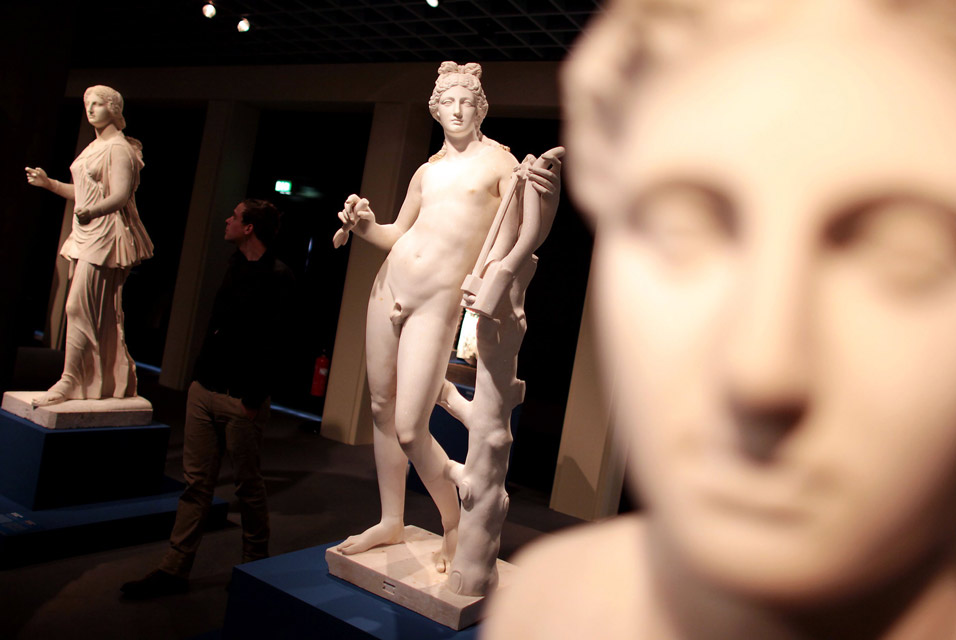
Antiquities. For the first time in Cologne, in the exhibition The
Return of the Gods, the Olympian world of the Greek gods is recreated
with marble statues, stone reliefs, bronzes and luxurious vases from the
Berlin collections – a cross section of outstanding European art from
early Greek times to the imperial Roman period.
Zeus, Hades, Poseidon – the Father Gods
Zeus, the Romans’ Jupiter, was the majestic ruler of the Olympian world. As the lord of the heavens, he carried a thunderbolt as his weapon. Zeus was the father of nu-merous gods and heroes; most of his offspring were not begotten with his wife Hera, but were the result of his many erotic liaisons.
Poseidon was the master of the sea,
inland waters and storms. As the “shaker of the Earth”, who made the
Earth tremble with his trident, he was held responsible for earthquakes
and natural disasters. People also venerated him as the protector of
their ships. The Romans called this god Neptune.
Brother of Zeus and Poseidon was Hades,
the Romans’ Pluto. He became the lord of the underworld when the gods
drew lots to divide the world between them.
All these “Father Gods” are represented
as mature, dignified and mighty. Zeus the father of the gods, Hades the
ruler of the underworld and Poseidon the god of the sea, are difficult
to tell apart when not depicted with their characteristic attributes
Asclepius, the Healing God
Asclepius was the god of medicine and healing. He was the son of Apollo and a mortal woman, so merely a demigod. He was nevertheless worshipped as a god but not regarded as one of the Olympian gods.
Asclepius’ place was among the people.
He is represented in the likeness of a Greek citizen: bearded, wearing a
robe and leaning on a staff. A snake is coiled around his staff and the
staff (or rod) of Asclepius is still the traditional symbol of
medicine.
Asclepius had many sanctuaries that
attracted throngs of worshippers, where the sick sought cures through
healing sleep (incubation). A centre of his cult developed at Epidaurus
and another was located on the island of Kos. The physicians of Kos
achieved great fame in the 5th century BC. The best known was
Hippocrates and, even today, doctors swear the “Hippocratic Oath”.
The cult of Asclepius reached the
western part of the Roman Empire in 293 BC when the Epidaurus sanctuary
established a shrine to the Latinised Aesculapius on Rome’s Tiber
Island.
Hera and Demeter – the Mothers
Hera, the Romans’ Juno, was the sister and spouse of Zeus. As the queen of the gods she watched over marriage and legitimate offspring. She therefore pursued the amorous escapades of her husband with jealous severity.
Demeter, Ceres for the Romans, was the
goddess of the fertile earth, of grain and agriculture. According to the
“Homeric” hymn to Demeter, her daughter Kore was abducted by Hades and,
as Persephone/Proserpina, became his wife in the under-world. Searching
for her daughter, the desperate Demeter neglected her responsibilities
as the goddess of agriculture, which led to a severe drought. Only after
the return of her daughter for two-thirds of the year did she allow
everything to grow and flourish again, but Kore-Persephone had to spend
one third of each year with Hades in the underworld, during which time
nature was also dead.Demeter and Hera are usually depicted as
motherly goddesses, often wearing a dia-dem and veil. When ears of
wheat – a specific attribute of Demeter – are not shown, it is scarcely
possible to distinguish between the two.
Aphrodite and Hermes
Aphrodite’s sphere of influence was love; her son Eros was the personified god of love. From the 5th century BC onwards, Aphrodite was depicted in ever more reveal-ing clothes: light and flimsy garments accentuated the beauty of the female body. Aphrodite first appeared completely naked in the 4th century BC, as a statue by Praxiteles, whose visualisation of the goddess was widely copied. Venus, the Roman equivalent of Aphrodite, was said to be the mother of Aeneas. Hence she became the mythical ancestress of the family of the Julii, to which both Caesar and Augustus belonged.Hermes was the messenger of the gods, the god of roads, boundaries and herds-men, the patron of thieves. He guided the souls of the dead into the after-world.Hermes wore the clothes of a traveller: a short cape, a broad-brimmed hat and boots or sandals. Speed was suggested by wings attached to his hat, shoes or heels. In addition, he carried a messenger’s staff with two snakes (Kerykeion). The Roman equivalent of Hermes was Mercury, the god of commerce and economic prosperity.
Athena – the Patroness of Great Works
Athena was the wise daughter of Zeus. Before his marriage to Hera, Zeus was the husband of Metis, the goddess of wisdom. Zeus then swallowed his consort when she was pregnant with Athena because it had been prophesied that she would bear him a child stronger than himself, who would ultimately depose him. Athena was born when Hephaestus, the blacksmith god, cleaved open her father’s skull.Athena was the goddess of battle, depicted with a helmet, lance and shield. Another emblem was the “aegis”, a breastplate with the head of the Gorgon Medusa in the centre. Athena was the patroness of the crafts and all artistic activities. She is also said to have invented the flute. While playing it beside a stream, she saw a reflection of herself with her cheeks puffed out, and crossly cast the instrument aside. The satyr Marsyas retrieved the flute and later challenged Apollo to a musical contest.Many cities invoked the protection of Athena, especially Athens, where she was worshipped on the Acropolis. Her Roman equivalent was Minerva.
Apollo and Artemis – divine twins
The twins Apollo and Artemis were the children of Zeus and Leto. Jealous Hera pur-sued her rival relentlessly until, finally, the island of Delos allowed Leto to give birth to her children there.Apollo was the upholder of order in human society, slaying wrongdoers with his bow and sending pestilence as a punishment. He defended religious purity. His attribute was the laurel. He was also the god of oracles and divine prophesies, leader of the muses and a master of the lyre. He was depicted as an idealized youth with long hair.Artemis, the goddess of the hunt and huntsmen, represented unspoiled nature. Known since ancient times as the “Mistress of the Animals” and the “unconquered virgin”, she nurtured and protected young animals, but was also a huntress who killed her prey. Since the late classical period, she has usually been depicted as a young girl in a hunting tunic with a bow and a quiver full of arrows, often accompanied by an animal. Just as her brother was both the god of healing and the god of pestilence, so Artemis was the goddess of childbirth and the bringer of death in childbirth.
The Sanctuary
In the Greek and Roman world, the sanctuary was the most important place for wor-shipping the gods. People would go there with votive offerings and gifts to praise or appease a deity and to ask for favours.
At larger ritual sites there were
temples with a cult image of the god. However, the centre of the
sanctuary was always the altar where sacrifices were offered. At public
ceremonies, cattle were often sacrificed: the priests would burn the
bones, fat and hide of the animal as an offering to the gods; the meat
would then be consumed by the worshippers at a ritual feast. Individual
citizens usually donated smaller animals, fruit or libations. The rites
could be accompanied by processions, dancing and music.
An abundance of offerings of various
types would accumulate at such sacred sites. Large objects like statues
would be set up on display while smaller votive objects, such as
miniature figurines or weapons captured from the enemy, were deposited
somewhere. In large Greek sanctuaries, Olympia and Delphi for example,
there were also treasuries where valuable offerings were stored.
Dionysus and the Theatre
Dionysus was the god of wine and delirious ecstasy. Those who gave themselves to this god had to risk becoming “possessed”. Dionysus was surrounded by a retinue (thiasos) of half-wild hybrid creatures, youthful satyrs, older sileni, and frenzied maenads who often danced to the music of flutes and drums.
Dionysus was depicted as child, as a
seductive youth with a body that is sometimes rather feminine, and as an
old man leaning on a satyr. His attributes were the ivy, either as a
wreath to prevent intoxication or wound around a staff (thyrsos), and a
drinking vessel (kantharos). He always symbolised a hedonistic way of
life.
Greek theatre originated in the cult of
Dionysus. In many places of worship, dramatic performances were part of
his festivals. Starting in Athens in the 6th century BC, first
tragedies, then “satyr” plays and – after 486 BC – comedies were
performed during the Great Dionysia festival. All the roles in the
plays, even female roles, were taken by three male actors wearing
costumes and masks, accompanied by a choir.
The Pergamon Altar
In the conflicts to succeed Alexander the Great, Philhetairos was able to establish his rule in Asia Minor, at Pergamon. His grandson, Attalos I, took the title of King. The latter’s son, Eumenes II (197-159 BC), defeated the invading Celts and developed the fortress into a Hellenistic city with prestigious marble buildings.The religious centre was the altar of Zeus, which was visible from afar. A flight of steps led up to a podium and the colonnaded area with the altar for burnt offerings. The podium was decorated on all sides by a frieze depicting the battle of the gods against the giants. The rear walls illustrated the history of the founding of Pergamon. Acroteria with figures stood on the roof.
Ετικέτες
aphrodite,
Apollo,
Artemis,
Asclepius,
Athena,
Demeter,
Hades,
hera,
hermes,
Poseidon,
the Healing God,
The Pergamon Altar,
The Return of the Gods,
Zeus
Παρασκευή 11 Μαΐου 2012
Poseidon the Greek God of the Sea
One of the twelve great Olympian gods, Poseidon was the Greek god of the sea whose fearsome rage could bring violent storms and earthquakes on the world. Homer calls him ''Earth-holder'' and as lord of earthquakes,Earth-shaker. He vividly depicts the mighty god as he journeys across his territory {Iliad 13.23-30): He harnessed to his chariot his two bronze-shod horses, swift of foot,with long, streaming manes of gold. Himself clothed in gold, he seized his well-wrought golden whip, then climbing into his chariot he drove across the waves. On every side, from the deeps of the sea, came dolphins,playing in his path, acknowledging their lord, and the sea parted in joy, cleaving a path before him. So swiftly sped the horses that never once was the axle of bronze beneath made wet with foam.
Poseidon was one of the six children of the Titans Cronus and Rhea, swallowed and later regurgitated by his cannibalistic father.When Cronus had been defeated and his three sons divided the universe among themselves, they kept the earth and Olympus as common property, while Zeus took the heavens as his domain, Hades the misty darkness of the Underworld, and Poseidon the seas. According to Homer, there was a time when Poseidon rebelled, conspiring with Hera and Athena to put Zeus in chains. But the sea-goddess Thetis saved him, sending Briareos to release him.Poseidon vied with Apollo for the love of Hestia, the goddess of the hearth, but she rejected both of them, swearing a vow of eternal chastity. He also vied with Zeus for the love of Thetis, but both gods withdrew their suit when they learnt that she was destined to bear a son mightier than his father. Poseidon's wooing of the Nereid Amphitrite came to a happier conclusion: with the help of a dolphin,who found her when she fled into hiding, he won her for his wife.With her he lived in a splendid golden palace in the depths of the sea. She bore him a son, the merman Triton, and two daughters, Rhode and Benthesicyme. But Poseidon was one of the most prolific of the gods and fathered numerous children on many mistresses. He himself could be violent and vindictive, and some of his sons inherited his dangerous nature, such as the evil Sciron, Sinis and Cercyon,all killed by Theseus; the boxer Amycus, killed by Polydeuces;and the Egyptian king Busiris, killed by Heracles.Some of his formidable offspring were giants, such as the Siamese twins, the Moliones;Otus and Ephialtes, who attempted to take over Olympus;the wrestler Antaeus, who was killed by Heracles; the great hunter Orion; Lamus, who founded the Laestrygonians, a race of maneating giants; and perhaps best-known of all, the Cyclops Polyphemus, who was blinded by Odysseus.
Others of Poseidon's more famous children were the twins Pelias and Neius, whom he fathered on Tyro, taking the shape of the rivergod Enipeus; Libya's three sons, Belus, Agenor and Lelex; Eumolpus,the son of Chione(, who was thrown into the sea by his mother and reared by Poseidon's daughter Benthesicyme; the navigator Nauplius, fathered on the Danaid Amymone while she was hunting for water in Argos; Hippothoon, the son of Alope, who was suckled by a mare and reared by shepherds after Alope was cruelly killed by her father; and of course the great Athenian hero, Theseus, borne to Poseidon by Aethra.
Poseidon was also the god of horses, and in this guise was known as Poseidon Hippios, 'Horse Poseidon'. As a horse he mated with the goddess Demeter, who bore him the divine horse, Areion, and a daughter, Despoina. Medusa was pregnant by him when she was killed by Perseus, and from her severed neck were born the winged horse, Pegasus, and Chrysaor. Poseidon presented wondrous horses to favoured mortals, both to Pelops, to help him win the hand of Hippodameia, and to his son Idas, to help him win the hand of Marpessa. To Peleus he gave as a wedding present the immortal horses Xanthus and Balius, who were later taken by Achilles to fight at Troy. The god showed his favour to other mortals in rather different ways. He made love to Caenis while she was wandering alone on the seashore, then at her own request turned her into a man, Caeneus,and made her invulnerable. He also made his son Cycnus invulnerable, and on his death at Achilles' hands turned him into a swan.He gave to his mistress Mestra, daughter of Erysichtheon, and to his grandson Periclymenus the ability to change their shape at will.Like other sea-deities, Poseidon himself had the power of changing his own shape. He came to Theophane as a ram, and fathered on her the flying, talking ram with the golden fleece which saved Phrixus and Helle from their wicked stepmother Ino, and which later became the motive for the long and arduous journey of Jason and the Argonauts.According to Ovid, Poseidon coupled with Canace, the daughter of Aeolus, as a bull, with Melantho, the daughter of Deucalion,as a dolphin, and with the Gorgon Medusa as a bird.Being a mighty and formidable god,Poseidon sternly punished the mortals who offended him. He was furious with Odysseus for blinding the Cyclops Polyphemus and kept him away from his homeland of Ithaca for many long, weary years; and he punished the Phaeacians, the people of Scheria, for helping Odysseus on his journey.
When Laomedon, king of Troy, refused to pay Poseidon and Apollo the agreed wage for building his city walls, the sea-god sent a sea-monster against the land, which would have devoured Hesione,Laomedon's daughter, had she not been saved by Heracles. Laomedon's offence was the reason for Poseidon's resentment of the Trojans and his support for the Greeks during the Trojan War. He frequently intervened to help his favourites, even against the express command of Zeus. This did not stop him helping Athena to punish the Greeks at the end of the war for the rape of the Trojan prophetess Cassandra by Ajax the sea-god sent violent storms that wrecked the Greek fleet off Cape Caphareus and brought death to many, including Ajax himself.At the Nereid's request, Poseidon sent another sea-monster against the Ethiopians, to punish a vain boast made by their queen, Cassiopeia.This time the monster's victim was to be the queen's daughter, Andromeda, but she was saved by Perseus. Poseidon was also associated with bulls: he brought death to Hippolytus, at the request of his father Theseus, by sending a bull from the sea that caused his horses to bolt and overturn his chariot. He sent as a gift to Minos, king of Crete, a magnificent white bull from the sea, then punished the king for failing to sacrifice it by inflicting on his wife,Pasiphae, a passion for the bull that led to the birth of the Minotaur.Poseidon came into conflict with some of the other gods over the
patronship of certain lands. He and Athena contested the possession of Attica during the reign of Cecrops. Both demonstrated their divine powers, Poseidon by creating a well of sea-water on the Acropolis of Athens, Athena by planting an olive tree. Athena's was judged the greater benefit, so the land became hers. Poseidon in anger sent a flood to cover Attica. He also quarrelled with Hera over the possession of Argos. The river-gods Inachus, Cephissus and Asterion judged the dispute in favour of Hera, and Poseidon, angry once again, dried up their waters. He was more fortunate in the case of Corinth,which he disputed with the Sun-god, Helios. The Hundred-hander Briareos was called in as arbitrator, and he awarded the citadel of
Acrocorinth to Helios and the Isthmus to Poseidon.
Poseidon was worshipped throughout the Greek world and from very early times: his name occurs on Mycenean Linear B tablets more frequently than that of any other divinity. At Rome he was identified
with the sea-god Neptune. He is a popular subject in ancient art, easily recognised by his most famous attribute, the trident, though he sometimes holds a fish and is often accompanied by sea creatures.
Occasionally he rides a hippocamp (a hybrid with the foreparts of a horse and the tail of a fish). Popular too in postclassical art, he figures prominently in sea-triumphs with his wife Amphitrite and is a natural subject for fountain-figures, such as on the famous Trevi Fountain at Rome. His marble temple on the promontory of Sounion in Attica, built in the late fifth century BC, is still a landmark for sailors.
Poseidon was one of the six children of the Titans Cronus and Rhea, swallowed and later regurgitated by his cannibalistic father.When Cronus had been defeated and his three sons divided the universe among themselves, they kept the earth and Olympus as common property, while Zeus took the heavens as his domain, Hades the misty darkness of the Underworld, and Poseidon the seas. According to Homer, there was a time when Poseidon rebelled, conspiring with Hera and Athena to put Zeus in chains. But the sea-goddess Thetis saved him, sending Briareos to release him.Poseidon vied with Apollo for the love of Hestia, the goddess of the hearth, but she rejected both of them, swearing a vow of eternal chastity. He also vied with Zeus for the love of Thetis, but both gods withdrew their suit when they learnt that she was destined to bear a son mightier than his father. Poseidon's wooing of the Nereid Amphitrite came to a happier conclusion: with the help of a dolphin,who found her when she fled into hiding, he won her for his wife.With her he lived in a splendid golden palace in the depths of the sea. She bore him a son, the merman Triton, and two daughters, Rhode and Benthesicyme. But Poseidon was one of the most prolific of the gods and fathered numerous children on many mistresses. He himself could be violent and vindictive, and some of his sons inherited his dangerous nature, such as the evil Sciron, Sinis and Cercyon,all killed by Theseus; the boxer Amycus, killed by Polydeuces;and the Egyptian king Busiris, killed by Heracles.Some of his formidable offspring were giants, such as the Siamese twins, the Moliones;Otus and Ephialtes, who attempted to take over Olympus;the wrestler Antaeus, who was killed by Heracles; the great hunter Orion; Lamus, who founded the Laestrygonians, a race of maneating giants; and perhaps best-known of all, the Cyclops Polyphemus, who was blinded by Odysseus.
Others of Poseidon's more famous children were the twins Pelias and Neius, whom he fathered on Tyro, taking the shape of the rivergod Enipeus; Libya's three sons, Belus, Agenor and Lelex; Eumolpus,the son of Chione(, who was thrown into the sea by his mother and reared by Poseidon's daughter Benthesicyme; the navigator Nauplius, fathered on the Danaid Amymone while she was hunting for water in Argos; Hippothoon, the son of Alope, who was suckled by a mare and reared by shepherds after Alope was cruelly killed by her father; and of course the great Athenian hero, Theseus, borne to Poseidon by Aethra.
Poseidon was also the god of horses, and in this guise was known as Poseidon Hippios, 'Horse Poseidon'. As a horse he mated with the goddess Demeter, who bore him the divine horse, Areion, and a daughter, Despoina. Medusa was pregnant by him when she was killed by Perseus, and from her severed neck were born the winged horse, Pegasus, and Chrysaor. Poseidon presented wondrous horses to favoured mortals, both to Pelops, to help him win the hand of Hippodameia, and to his son Idas, to help him win the hand of Marpessa. To Peleus he gave as a wedding present the immortal horses Xanthus and Balius, who were later taken by Achilles to fight at Troy. The god showed his favour to other mortals in rather different ways. He made love to Caenis while she was wandering alone on the seashore, then at her own request turned her into a man, Caeneus,and made her invulnerable. He also made his son Cycnus invulnerable, and on his death at Achilles' hands turned him into a swan.He gave to his mistress Mestra, daughter of Erysichtheon, and to his grandson Periclymenus the ability to change their shape at will.Like other sea-deities, Poseidon himself had the power of changing his own shape. He came to Theophane as a ram, and fathered on her the flying, talking ram with the golden fleece which saved Phrixus and Helle from their wicked stepmother Ino, and which later became the motive for the long and arduous journey of Jason and the Argonauts.According to Ovid, Poseidon coupled with Canace, the daughter of Aeolus, as a bull, with Melantho, the daughter of Deucalion,as a dolphin, and with the Gorgon Medusa as a bird.Being a mighty and formidable god,Poseidon sternly punished the mortals who offended him. He was furious with Odysseus for blinding the Cyclops Polyphemus and kept him away from his homeland of Ithaca for many long, weary years; and he punished the Phaeacians, the people of Scheria, for helping Odysseus on his journey.
When Laomedon, king of Troy, refused to pay Poseidon and Apollo the agreed wage for building his city walls, the sea-god sent a sea-monster against the land, which would have devoured Hesione,Laomedon's daughter, had she not been saved by Heracles. Laomedon's offence was the reason for Poseidon's resentment of the Trojans and his support for the Greeks during the Trojan War. He frequently intervened to help his favourites, even against the express command of Zeus. This did not stop him helping Athena to punish the Greeks at the end of the war for the rape of the Trojan prophetess Cassandra by Ajax the sea-god sent violent storms that wrecked the Greek fleet off Cape Caphareus and brought death to many, including Ajax himself.At the Nereid's request, Poseidon sent another sea-monster against the Ethiopians, to punish a vain boast made by their queen, Cassiopeia.This time the monster's victim was to be the queen's daughter, Andromeda, but she was saved by Perseus. Poseidon was also associated with bulls: he brought death to Hippolytus, at the request of his father Theseus, by sending a bull from the sea that caused his horses to bolt and overturn his chariot. He sent as a gift to Minos, king of Crete, a magnificent white bull from the sea, then punished the king for failing to sacrifice it by inflicting on his wife,Pasiphae, a passion for the bull that led to the birth of the Minotaur.Poseidon came into conflict with some of the other gods over the
patronship of certain lands. He and Athena contested the possession of Attica during the reign of Cecrops. Both demonstrated their divine powers, Poseidon by creating a well of sea-water on the Acropolis of Athens, Athena by planting an olive tree. Athena's was judged the greater benefit, so the land became hers. Poseidon in anger sent a flood to cover Attica. He also quarrelled with Hera over the possession of Argos. The river-gods Inachus, Cephissus and Asterion judged the dispute in favour of Hera, and Poseidon, angry once again, dried up their waters. He was more fortunate in the case of Corinth,which he disputed with the Sun-god, Helios. The Hundred-hander Briareos was called in as arbitrator, and he awarded the citadel of
Acrocorinth to Helios and the Isthmus to Poseidon.
Poseidon was worshipped throughout the Greek world and from very early times: his name occurs on Mycenean Linear B tablets more frequently than that of any other divinity. At Rome he was identified
with the sea-god Neptune. He is a popular subject in ancient art, easily recognised by his most famous attribute, the trident, though he sometimes holds a fish and is often accompanied by sea creatures.
Occasionally he rides a hippocamp (a hybrid with the foreparts of a horse and the tail of a fish). Popular too in postclassical art, he figures prominently in sea-triumphs with his wife Amphitrite and is a natural subject for fountain-figures, such as on the famous Trevi Fountain at Rome. His marble temple on the promontory of Sounion in Attica, built in the late fifth century BC, is still a landmark for sailors.
Πέμπτη 10 Μαΐου 2012
The Nature of the Greek Gods

The primary dimension is that of cult (religious practice). Greeks prayed, sacrificed,poured libations, held festivals, demarcated places which would be precincts, built altars and temples, gave gifts and built ‘‘treasuries’’ to hold them all. In doing all this they represented themselves as performing acts to, for, or at least with an audience of, gods. It is far from unusual to have many gods (‘‘polytheism’’) or to think of them somehow as persons. But by the standards of other nations, Greek gods were exceptionally anthropomorphic – they were ‘‘shaped like people.’’ The focus of Greek worship tended not to be mighty stones or trees (‘‘aniconic,’’ non-representational, objects of worship), though they admired those too, but stone or wood shaped into statues of personal gods. Each god was an individual person and each was thought of as having their particular identity.Different Greek cities or ethne¯ (peoples who were not yet urbanized) worshiped broadly similar gods to each other. But the system was far from uniform and the Zeus
imagined in one place might be rather different from the Zeus imagined in another.Indeed, in a single place you might worship a variety of Zeuses, distinguished by their epithets – so Zeus ‘‘Meilichios,’’ Zeus the dangerous but hopefully ‘‘gentle,’’ is a different business from Zeus ‘‘Olympios,’’ the Zeus who is king of the gods on Mount Olympus. Each Olympian god is particularized by epithets, which are a bit of compromise: they maintain a single identity (of Zeus), but diffract it into a rich spectrum of locations, functions, and traditions.
The second dimension is that of mythology. Myths might be local and might present for instance a supposed reason for a current religious practice, when they are described as ‘‘aetiological.’’ This would not be an actual, historical reason, because myths are no more true than gods are real. They are a way of thinking about the world around us and the people in it. It is in the nature of the worship of the Greek gods to generate myths,and it is in the nature of poets, the entertainers of Greek culture, to collect them and
synthesize them into a compromise set of stories that develop shared ideas of what the gods are like and how they behave. The principal Greek myths are widely known in ancient Greece and find their place in epics, lyric poetry, drama, and all manner of cultural production. They are everywhere in Greek art too.
The third dimension is that of thought about gods and the divine, ‘‘theology.’’ But Greece did not have official theologians: what it had was poets, philosophers, and anyone else who was prepared to think. Here finally we may worry about how the universe is run and speculate on the justice or the goodness of the gods. It is at this point that personal gods have their weakest grip and abstraction sets in most easily.So, to take the major cult site of Zeus in the Peloponnese, the huge temple of Zeus at Olympia (built for cult, decorated with myth) provokes reflection on his power (theology). The ceremonies and celebrations enact that power with grandeur and significance, and in so doing focus something of Greek identity onto this site. This happens explicitly once every four years and implicitly, through memory and monuments, at all times in between, as this is always the place that carries the history of the ritual and its apparently limitless future. The huge altar of ashes grows with this year’s offerings; and the animals sacrificed in large number to the god, awesomely struck down and wailed over, give their lifeblood not to us but (back) to the god. This is the ‘‘same’’ Zeus whom Homer celebrates in the Iliad, mighty, remote, never actually walking the earth, distributing human happiness and misery, deciding the end of everything, including us. But he also behaves in ways that are harder to understand: he is said to have flung the god Hephaestus from heaven to land on Lemnos where the worship of the god of fire can take place; he argues with his wife (for why else should their marriage need to be renewed annually?); he is seduced by her on Mount Ida, in a scene presented rather daringly or wickedly by the poet.
synthesize them into a compromise set of stories that develop shared ideas of what the gods are like and how they behave. The principal Greek myths are widely known in ancient Greece and find their place in epics, lyric poetry, drama, and all manner of cultural production. They are everywhere in Greek art too.
The third dimension is that of thought about gods and the divine, ‘‘theology.’’ But Greece did not have official theologians: what it had was poets, philosophers, and anyone else who was prepared to think. Here finally we may worry about how the universe is run and speculate on the justice or the goodness of the gods. It is at this point that personal gods have their weakest grip and abstraction sets in most easily.So, to take the major cult site of Zeus in the Peloponnese, the huge temple of Zeus at Olympia (built for cult, decorated with myth) provokes reflection on his power (theology). The ceremonies and celebrations enact that power with grandeur and significance, and in so doing focus something of Greek identity onto this site. This happens explicitly once every four years and implicitly, through memory and monuments, at all times in between, as this is always the place that carries the history of the ritual and its apparently limitless future. The huge altar of ashes grows with this year’s offerings; and the animals sacrificed in large number to the god, awesomely struck down and wailed over, give their lifeblood not to us but (back) to the god. This is the ‘‘same’’ Zeus whom Homer celebrates in the Iliad, mighty, remote, never actually walking the earth, distributing human happiness and misery, deciding the end of everything, including us. But he also behaves in ways that are harder to understand: he is said to have flung the god Hephaestus from heaven to land on Lemnos where the worship of the god of fire can take place; he argues with his wife (for why else should their marriage need to be renewed annually?); he is seduced by her on Mount Ida, in a scene presented rather daringly or wickedly by the poet.
At Olympia we will also look forward to the traditional ritual song celebrating his thunderbolt, and we will think, as we look to the sky in prayer, about that great being whose justice is so hard to grasp, as Aeschylus showed us in his last plays – the Agamemnon and the Prometheus Bound (if it is by him). And as we look at the temple’s sculptures, we see a mythology surrounding Zeus – a pediment showing the chariot race of Pelops for the hand of Hippodameia, a pediment displaying Zeus’s son Apollo bringing order to Centaurs and Lapiths, and the metopes displaying the work of another of his sons,Heracles, founder of the Olympic Games, namely his twelve labors to civilize the world and overcome the adversity that Zeus’s wife Hera had put in his path. Zeus himself once again is mysteriously absent from these scenes, but we may reflect upon
his world order and then enter the temple to see what came to be one of the seven wonders of the ancient world, the huge enthroned Zeus by Pheidias, a statue which changed the path of Greek art.Greek gods may not be neatly packaged, but that helps them to provoke thought as we bring together ideas from all the different places where we encounter them –participating in cult, watching cult, seeing the myth depicted, hearing it acted out,listening to it sung. You could only emerge humbled from the experience of Zeus.
Παρασκευή 30 Μαρτίου 2012
Zeus The Greek Supreme God
The Greek supreme god of all living and all creation came at a great
price. Cronus and Rhea was his parents, Cronus was a titian and Rhea was
considered as a Titan too due to her parents which were Gaia and
Ouranos. She was known by most as The Mother Of The Gods. She was also
Cronus sister as well as spouse. Due to that Cronus had over powered his
own father and became king of the Gods he feared that his own children
would do the same thing to him as well as that Gaia and Ouranos had told
him that his children would rise up against him and take the throne for
themselves. So as Rhea had his children he would swallow them. They
would not die but just be trapped within his body they would grow inside
of him just as they would have in the world. He done this every time
just as soon as the children were born. Rhea soon grew tiered of this
and her and her parents came up with a plan to save one of the baby’s.
This baby was Zeus.
Rhea tricked Cronus into eating a rock that was wrapped up like a baby and he swallowed it while Zeus was taken to Mount Dicte in Crete where he was raised by Cynosura and Adamanthea who was nymphs. He was raised by many gods and other beings, He was suckled by The Goat named Amalthea with milk and honey in later years after Amalthea died Zeus took her skin and turned it into his royal shield known as Aegis to honor her for what she did for him. The small gods known as Kouretes soldiers would dance, clash their swords and shout to keep the cry of the baby from Cronus’s ears. In his later years a shepherd family raised him for while and taught him what they knew. Along with Gaia. In a part of his infancy Cynosura had dangled Zeus on a rope to keep him out of sight from his father due to Cronos being able to see and ruled over the heavens, Earth and the seas. So with Zeus being dangled on a rope he was in between of what Cronos could view.
After protecting Zeus and watching him grow into a nice and strong
young man he son became an attendant to Cronus his father. Cronus never
expected to be taken down by his servant and never give it another
thought.Soon Rhea, Zeus mother and the titan goddess of wisdom Metis made up a
potion for Cronus to drink. Soon after he drank it he became very sick
to his stomach and soon vomited his children up.After Demeter, Hades, Hera, Hestia, and Poseidon was threw up they
were in a complete out rage due to their many years of imprisonment has
decided to wage war on the Titans and take over the throne of Cronus.
Zeus being so wise he called to his siblings and told them that they
would need help from the powerful allies as well as weapons.So they came
up with a plan that would change the heavens forever.
The one eyed giants known as The Cyclopes were released from their imprisonment in Tartarus known by many as Hell. They were much grateful for their release and was willing to help them and gave them great gifts that would help in defeating the great Titans.To Zeus they gave him his thunder bolts, the trident was bestowed on Poseidon and last but not least was the helmet that when worn would turn you invisible and that gift was bestowed upon Hades.After they were well armed the battle began against their father. It was not an easy battle for it took over ten years to finish this battle and was very bloody but they soon conquered him as well as the other titans. The three brothers worked together. Hades wearing the helmet slipped up behind Cronus and with the Trident Poseidon immobilized Cronus while Zeus threw a thunderbolt at Cronus knocking him unconscious. Even with the victory of this the reign of the Olympians had just started and it would last forever. All of the Titans were drove defeated into the pits of Tartarus. After many generation of mortal life Cronus and the rest of the Titans were set free. Cronus resided as King of time in the Elysian Islands.
After the battle was over and the titans were placed in imprisonment the three brothers drew lots and divided up the heavens and earth between them. Zeus was made the supreme ruler due to what he draw, Hades was made God of the underworld and the sea and all waters went to Poseidon. But they all agreed to share the ruling of the earth and all of the mortals and creatures that roamed the earth.Zeus having acquiring his new powers and position he soon got above every one and let this go to his head and he had a bad habit of abusing his powers for many a years. He built a palace way above the clouds on Mount Olympus and would punish any one that displeased him or misinformed him by throwing his lighting bolts at them. This happen very often.Soon Zeus grew lonely and wanted a wife so he pursued Metis because she had helped to rescue his siblings. She reclined him and changed her forum and hid from the Great Lord Zeus. He was so desperate to have her that he did not give up til she finally gave in and became his wife.. Metis soon became pregnant and when this happen Gaia became very upset at how Zeus was acting and gave him a prophecy that any son of Zeus and Metis would over throw his father and take control of it. Upon this news he swallowed Metis to keep her from having a son.
Metis was not going to have a son for it was a daughter who would soon become a great goddess as well. The child was born and grew with in the head of Zeus. he soon began to have terrible head aches that would end all head aches. After this went on for so many years the god of the forge Hephaestus created an golden axe for he seen how much misery Zeus was in. After the axe was forged he went to the Lord Zeus and split his head open to relive the pain and when he did this out stepped a beautiful fully grown woman clothed and ready to take her stance on the throne next to her father. She was Apollo goddess of war as well as her father’s most trusted adviser and ally.Zeus still being wild and not ready to settle down after Metis he had his way with many of the goddess and mortals. He would transform himself into many things to seduce them and had many children before he deiced to marry and after he was married to Hera.
He decided that Hera would be his bride but she was not interested in him due to his childishness ways. He was determined to marry her so he turned himself into a cuckoo then created a thunder storm that drenched him. Hera with the kind heart that she had she picked up the little bird and held it close to her heart trying to get it warm. As she did so Zeus changed into himself and told her that he was just as vulnerable as that bird and for her to take pity on him as she did the cuckoo for he was madly in love with her. After this happen Hera soon realized that she too love him and consented to his proposal. She became the Queen of the Heavens. Everyone thought that after marring Hera Zeus would calm down and she did manage to calm him down a bit. All was so jealous of Hera because she was so loved by the Lord God Zeus. Some says that their marriage went great with a 300 year honeymoon but soon died and he started roaming again with other lovers.
Zeus had many wives goddesses as well as mortal lovers and all bore his children Metos who was goddess of wisdom was his first wife and she bore Athena.Themis was his second wife and bore to him Dike, Eirene, Eunomia, Horae, and Fates.Titaness was his third wife and bore to him nine children who became the Muses.Leto was his fourth wife whom he seduced forced her to marry him and she bore to him the twins, Appolo and Artemis.Hera was his final and last wife she was his permanent companion and
bore him four children who was Hephaestus, Ares, Hebe and Eileithyae. It
has been said that Hera born Hephaestus on her own and he had no father
at all. But it is still said that Zeus is his father.Zeus had many children including the most well known Hercules.
In one story of how Zeus got Hera was that he turned himself into an
injured bird and Hera felt sorry for the little creature and she picked
it up holding it close to her breast to give it warmth and Zeus took
advantage of this then raped Hera. Hera married him only to cover up her
shame of what happen but she did not love him and was cruel-hearted to
him. She had at one time tried to make things work between them but Zeus
not being a very faithful husband and sleeping with many lovers she
lost all that she may have had for him and started planing her revenge
against him and all of his lovers and children that were born from his
cheating.
Hera so displeased with the things that Zeus did and they way he was
ruling was like a child and her and the other gods was very displeased
with this so Hera thought up of a way to get rid of Zeus and over throw
him. Hera drugged him and the others took him and tied him to a couch in
a rope that was on breakable. There was so many ties that there was no
way that he could get free on his own. But he had friends in high places
that was still loyal to him, Briareus had over heard the quarreling of
the others and decided to sneak in to see what was going on. The gods
and goddesses were all not paying any attention to Zeus thinking that he
was out of the picture that Briareus was able to untie him farley fast.
As soon as he had him untied Zeus sprang from the couch and instantly
grabbed his thunder bolt. The Gods and goddesses all fell to their knees
begging forgiveness.He dealt with each of them but Hera got the worst punishment of them
all. she was hung from the stars in gold chains and heavy anvils on her
her ankles. For three nights and days she hang there moaning and
groaning not letting Zeus get any peace nor sleep so her told her that
he would let her go if she made a promise to him that she would never go
against him every again or do any trickery to him. She had no choice
but to agree to this so she did and he released her. Even though she
never went against him ever again she still out witted him many times as
well as to butt into his plans and ruin them.
The plot against him seem to get through some what and he began to
shape up as the leader he should have been he was merciful and gave the
right punishments for the rightful crime committed. Some times he would
not even punish those who wronged him but warned them some times. All
went back to normal Zeus became the highest ranking God of all of the
Mount Olympus.He was not such of an arrogant ruler any more although his lust was
never satisfied and his marriage was never happy for Hera was never
pleased over his affairs and what woman would be.
Rhea tricked Cronus into eating a rock that was wrapped up like a baby and he swallowed it while Zeus was taken to Mount Dicte in Crete where he was raised by Cynosura and Adamanthea who was nymphs. He was raised by many gods and other beings, He was suckled by The Goat named Amalthea with milk and honey in later years after Amalthea died Zeus took her skin and turned it into his royal shield known as Aegis to honor her for what she did for him. The small gods known as Kouretes soldiers would dance, clash their swords and shout to keep the cry of the baby from Cronus’s ears. In his later years a shepherd family raised him for while and taught him what they knew. Along with Gaia. In a part of his infancy Cynosura had dangled Zeus on a rope to keep him out of sight from his father due to Cronos being able to see and ruled over the heavens, Earth and the seas. So with Zeus being dangled on a rope he was in between of what Cronos could view.
The one eyed giants known as The Cyclopes were released from their imprisonment in Tartarus known by many as Hell. They were much grateful for their release and was willing to help them and gave them great gifts that would help in defeating the great Titans.To Zeus they gave him his thunder bolts, the trident was bestowed on Poseidon and last but not least was the helmet that when worn would turn you invisible and that gift was bestowed upon Hades.After they were well armed the battle began against their father. It was not an easy battle for it took over ten years to finish this battle and was very bloody but they soon conquered him as well as the other titans. The three brothers worked together. Hades wearing the helmet slipped up behind Cronus and with the Trident Poseidon immobilized Cronus while Zeus threw a thunderbolt at Cronus knocking him unconscious. Even with the victory of this the reign of the Olympians had just started and it would last forever. All of the Titans were drove defeated into the pits of Tartarus. After many generation of mortal life Cronus and the rest of the Titans were set free. Cronus resided as King of time in the Elysian Islands.
After the battle was over and the titans were placed in imprisonment the three brothers drew lots and divided up the heavens and earth between them. Zeus was made the supreme ruler due to what he draw, Hades was made God of the underworld and the sea and all waters went to Poseidon. But they all agreed to share the ruling of the earth and all of the mortals and creatures that roamed the earth.Zeus having acquiring his new powers and position he soon got above every one and let this go to his head and he had a bad habit of abusing his powers for many a years. He built a palace way above the clouds on Mount Olympus and would punish any one that displeased him or misinformed him by throwing his lighting bolts at them. This happen very often.Soon Zeus grew lonely and wanted a wife so he pursued Metis because she had helped to rescue his siblings. She reclined him and changed her forum and hid from the Great Lord Zeus. He was so desperate to have her that he did not give up til she finally gave in and became his wife.. Metis soon became pregnant and when this happen Gaia became very upset at how Zeus was acting and gave him a prophecy that any son of Zeus and Metis would over throw his father and take control of it. Upon this news he swallowed Metis to keep her from having a son.
Metis was not going to have a son for it was a daughter who would soon become a great goddess as well. The child was born and grew with in the head of Zeus. he soon began to have terrible head aches that would end all head aches. After this went on for so many years the god of the forge Hephaestus created an golden axe for he seen how much misery Zeus was in. After the axe was forged he went to the Lord Zeus and split his head open to relive the pain and when he did this out stepped a beautiful fully grown woman clothed and ready to take her stance on the throne next to her father. She was Apollo goddess of war as well as her father’s most trusted adviser and ally.Zeus still being wild and not ready to settle down after Metis he had his way with many of the goddess and mortals. He would transform himself into many things to seduce them and had many children before he deiced to marry and after he was married to Hera.
He decided that Hera would be his bride but she was not interested in him due to his childishness ways. He was determined to marry her so he turned himself into a cuckoo then created a thunder storm that drenched him. Hera with the kind heart that she had she picked up the little bird and held it close to her heart trying to get it warm. As she did so Zeus changed into himself and told her that he was just as vulnerable as that bird and for her to take pity on him as she did the cuckoo for he was madly in love with her. After this happen Hera soon realized that she too love him and consented to his proposal. She became the Queen of the Heavens. Everyone thought that after marring Hera Zeus would calm down and she did manage to calm him down a bit. All was so jealous of Hera because she was so loved by the Lord God Zeus. Some says that their marriage went great with a 300 year honeymoon but soon died and he started roaming again with other lovers.
Ετικέτες
crete,
cronos,
cronus,
Cyclopes,
Greek gods,
greek polytheism,
hera,
Mount Olympus,
mythology,
Olympians,
rhea,
titans,
Zeus
Εγγραφή σε:
Αναρτήσεις (Atom)